Aggregate modulus
In relation to biomechanics, the aggregate modulus (Ha) is a measurement of the stiffness of a material at equilibrium when fluid has ceased flowing through it, under the application of a constant load or strain in a confined compression configuration.[1] The aggregate modulus can be calculated from Young's modulus (E) and the Poisson ratio (v).[1][2]
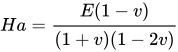
The aggregate modulus of a similar specimen is determined from a unidirectional deformational testing configuration, i.e., the only non-zero strain component is E11.[3] This configuration is opposed to the Young's modulus, which is determined from a unidirectional loading testing configuration, i.e., the only non-zero stress component is, say, in the e1 direction.[3] In this test, the only non-zero component of the stress tensor is T11.[3]
References
- ^ a b Mansour, J. M. (2003). Biomechanics of cartilage. Kinesiology: the mechanics and pathomechanics of human movement, 2, 66-79.
- ^ Boschetti, Federica; Pennati, Giancarlo; Gervaso, Francesca; Peretti, Giuseppe M.; Dubini, Gabriele (2004). "Biomechanical properties of human articular cartilage under compressive loads". Biorheology. 41 (3–4): 159–166. doi:10.1177/0006355X2004041003004001. ISSN 0006-355X. PMID 15299249.
- ^ a b c Loret, Benjamin; Simões, Fernando M. F. (2017-05-08), "Biomechanical topics in soft tissues", Biomechanical Aspects of Soft Tissues, Boca Raton, FL: CRC Press, pp. 1–10, doi:10.1201/9781315110783-1, ISBN 978-1-315-11078-3, retrieved 2022-03-15
 | This classical mechanics–related article is a stub. You can help Wikipedia by adding missing information. |
 | This biophysics-related article is a stub. You can help Wikipedia by adding missing information. |
Content Disclaimer
Informasi ini disarikan dari Wikipedia dan disajikan kembali untuk tujuan edukasi. Konten tersedia di bawah lisensi CC BY-SA 3.0. Kami tidak bertanggung jawab atas ketidakakuratan data yang bersumber dari kontribusi publik tersebut.
- The information displayed on this website is sourced in part or in whole from Wikipedia and has been adapted for the purpose of restating it. We strive to provide accurate and relevant information, however:
- There is no guarantee of absolute accuracy. Wikipedia is an open, collaborative project that can be edited by anyone, so information is subject to change.
- It is not intended to constitute professional advice. The content displayed is for informational and educational purposes only. For important decisions (e.g., medical, legal, or financial), please consult a professional.
- Content copyright. Wikipedia is licensed under the Creative Commons Attribution-ShareAlike License (CC BY-SA). This means that content may be reused with appropriate attribution and shared under a similar license.
- Responsible use. Any risk arising from the use of information from this website is entirely the responsibility of the user.