Anderson function

Anderson functions describe the projection of a magnetic dipole field in a given direction at points along an arbitrary line. They are useful in the study of magnetic anomaly detection, with historical applications in submarine hunting and underwater mine detection.[1] They approximately describe the signal detected by a total field sensor as the sensor passes by a target (assuming the targets signature is small compared to the Earth's magnetic field).
Definition
The magnetic field from a magnetic dipole along a given line, and in any given direction can be described by the following basis functions:
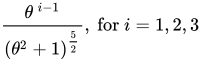
which are known as Anderson functions.[1]
Definitions:
- is the dipole's strength and direction
- is the projected direction (often the Earth's magnetic field in a region)
- is the position along the line
- points in the direction of the line
- is a vector from the dipole to the point of closest approach (CPA) of the line
- , a dimensionless quantity for simplification


The total magnetic field along the line is given by

where is the magnetic constant, and are the Anderson coefficients, which depend on the geometry of the system. These are[2]


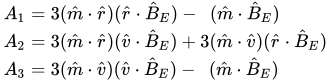
where and are unit vectors (given by and , respectively).


Note, the antisymmetric portion of the function is represented by the second function. Correspondingly, the sign of depends on how is defined (e.g. direction is 'forward').


Total field measurements
The total field measurement resulting from a dipole field in the presence of a background field (such as earth magnetic field) is

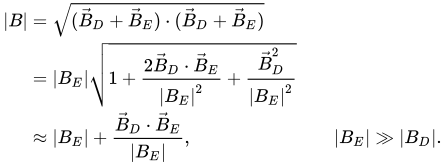
The last line is an approximation that is accurate if the background field is much larger than contributions from the dipole. In such a case the total field reduces to the sum of the background field, and the projection of the dipole field onto the background field. This means that the total field can be accurately described as an Anderson function with an offset.
References
- ^ a b Loane, Edward P. (12 October 1976). "Speed and Depth Effects in Magnetic Anomaly Detection". EPL ANALYSIS OLNEY MD.
{{cite journal}}: Cite journal requires|journal=(help) - ^ Baum, Carl E. (1998). Detection And Identification Of Visually Obscured Targets. CRC Press. p. 345. ISBN 9781560325338.
Content Disclaimer
Informasi ini disarikan dari Wikipedia dan disajikan kembali untuk tujuan edukasi. Konten tersedia di bawah lisensi CC BY-SA 3.0. Kami tidak bertanggung jawab atas ketidakakuratan data yang bersumber dari kontribusi publik tersebut.
- The information displayed on this website is sourced in part or in whole from Wikipedia and has been adapted for the purpose of restating it. We strive to provide accurate and relevant information, however:
- There is no guarantee of absolute accuracy. Wikipedia is an open, collaborative project that can be edited by anyone, so information is subject to change.
- It is not intended to constitute professional advice. The content displayed is for informational and educational purposes only. For important decisions (e.g., medical, legal, or financial), please consult a professional.
- Content copyright. Wikipedia is licensed under the Creative Commons Attribution-ShareAlike License (CC BY-SA). This means that content may be reused with appropriate attribution and shared under a similar license.
- Responsible use. Any risk arising from the use of information from this website is entirely the responsibility of the user.