Arithmetic surface
In mathematics, an arithmetic surface over a Dedekind domain with fraction field is a geometric object having one conventional dimension, and one other dimension provided by the infinitude of the primes. When is the ring of integers , this intuition depends on the prime ideal spectrum being seen as analogous to a line. Arithmetic surfaces arise naturally in Diophantine geometry, when an algebraic curve defined over is thought of as having reductions over the residue fields (where is a prime ideal of ) for almost all ; and are helpful in specifying what should happen about the process of reducing to when the most naive way fails to make sense.[clarification needed]


Such an object can be defined more formally as an -scheme with a non-singular, connected projective curve for a generic fiber and unions of curves (possibly reducible, singular, non-reduced) over the appropriate residue field for special fibers.

Formal definition
An arithmetic surface over a Dedekind domain is a scheme with a morphism such that is integral, normal, excellent, flat and of finite type over , and the generic fiber is a non-singular, connected projective curve over ; and for other in ,




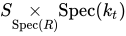
is a union of curves over .[1]

Over a Dedekind scheme
In even more generality, arithmetic surfaces can be defined over Dedekind schemes, a typical example of which is the spectrum of the ring of integers of a number field (which is the case above). An arithmetic surface is then a regular fibered surface over a Dedekind scheme of dimension one.[2] This generalisation is useful, for example, it allows for base curves which are smooth and projective over finite fields, which is important in positive characteristic.
Over Dedekind rings
Arithmetic surfaces over Dedekind domains are the arithmetic analogue of fibered surfaces over algebraic curves.[1] Arithmetic surfaces arise primarily in the context of number theory.[3] In fact, given a curve over a number field , there exists an arithmetic surface over the ring of integers whose generic fiber is isomorphic to . In higher dimensions, one may also consider arithmetic schemes.[3]


Properties
Dimension
Arithmetic surfaces have dimension 2 and relative dimension 1 over their base.[1]
Divisors
We can develop a theory of Weil divisors on arithmetic surfaces since every local ring of dimension one is regular. This is briefly stated as "arithmetic surfaces are regular in codimension one."[1] The theory is developed in Hartshorne's Algebraic Geometry, for example.[4]
Examples
Projective line
The projective line over Dedekind domain is a smooth, proper arithmetic surface over . The fiber over any maximal ideal is the projective line over the field [5]


Regular minimal models
Néron models for elliptic curves, initially defined over a global field, are examples of this construction, and are much studied examples of arithmetic surfaces.[6] There are strong analogies with elliptic fibrations.
Intersection theory
Given two distinct irreducible divisors and a closed point on the special fiber of an arithmetic surface, we can define the local intersection index of the divisors at the point as you would for any algebraic surface, namely as the dimension of a certain quotient of the local ring at a point.[7] The idea is then to add these local indices up to get a global intersection index. The theory starts to diverge from that of algebraic surfaces when we try to ensure linear equivalent divisors give the same intersection index, this would be used, for example in computing a divisors intersection index with itself. This fails when the base scheme of an arithmetic surface is not "compact". In fact, in this case, linear equivalence may move an intersection point out to infinity.[8] A partial resolution to this is to restrict the set of divisors we want to intersect, in particular forcing at least one divisor to be "fibral" (every component is a component of a special fiber) allows us to define a unique intersection pairing having this property, amongst other desirable ones.[9] A full resolution is given by Arakelov theory.
Arakelov theory
Arakelov theory offers a solution to the problem presented above. Intuitively, fibers are added at infinity by adding a fiber for each archimedean absolute value of . A local intersection pairing that extends to the full divisor group can then be defined, with the desired invariance under linear equivalence.[10]
See also
Notes
- ^ a b c d Silverman (1994), p. 311.
- ^ Liu (2002), chapter 8.
- ^ a b Eisenbud & Harris (2000), p. 81.
- ^ Hartshorne (1977), p. 130.
- ^ Silverman (1994), p. 312.
- ^ Silverman (1994), chapter IV.
- ^ Silverman (1994), p. 339.
- ^ Silverman (1994), p. 340.
- ^ Silverman (1994), p. 341.
- ^ Silverman (1994), p. 344.
References
- Eisenbud, David; Harris, Joe (2000). The Geometry of Schemes. Graduate Texts in Mathematics. Vol. 197. Springer. ISBN 978-0-387-98638-8. Zbl 0960.14002.
- Hartshorne, Robin (1977). Algebraic Geometry. Graduate Texts in Mathematics. Vol. 52. New York: Springer. ISBN 978-0-387-90244-9. Zbl 0367.14001.
- Lang, Serge (1988). Introduction to Arakelov Theory. New York: Springer. ISBN 978-0-387-96793-6. MR 0969124. Zbl 0667.14001.
- Liu, Qing (2002). Algebraic Geometry and Arithmetic Curves. Oxford Graduate Texts in Mathematics. Vol. 6. Oxford University Press. ISBN 978-0-19-850284-5.
- Silverman, Joseph H. (1994). Advanced Topics in the Arithmetic of Elliptic Curves. Graduate Texts in Mathematics. Vol. 151. New York: Springer. ISBN 978-0-387-94325-1. Zbl 0911.14015.
- Soulé, C.; Abramovich, D.; Burnol, J.-F.; Kramer, J. (1992). Lectures on Arakelov Geometry. Cambridge Studies in Advanced Mathematics. Vol. 33. Cambridge University Press. ISBN 978-0-521-47709-3. Zbl 0812.14015.
Content Disclaimer
Informasi ini disarikan dari Wikipedia dan disajikan kembali untuk tujuan edukasi. Konten tersedia di bawah lisensi CC BY-SA 3.0. Kami tidak bertanggung jawab atas ketidakakuratan data yang bersumber dari kontribusi publik tersebut.
- The information displayed on this website is sourced in part or in whole from Wikipedia and has been adapted for the purpose of restating it. We strive to provide accurate and relevant information, however:
- There is no guarantee of absolute accuracy. Wikipedia is an open, collaborative project that can be edited by anyone, so information is subject to change.
- It is not intended to constitute professional advice. The content displayed is for informational and educational purposes only. For important decisions (e.g., medical, legal, or financial), please consult a professional.
- Content copyright. Wikipedia is licensed under the Creative Commons Attribution-ShareAlike License (CC BY-SA). This means that content may be reused with appropriate attribution and shared under a similar license.
- Responsible use. Any risk arising from the use of information from this website is entirely the responsibility of the user.