Bergetiger
| Bergetiger | |
|---|---|
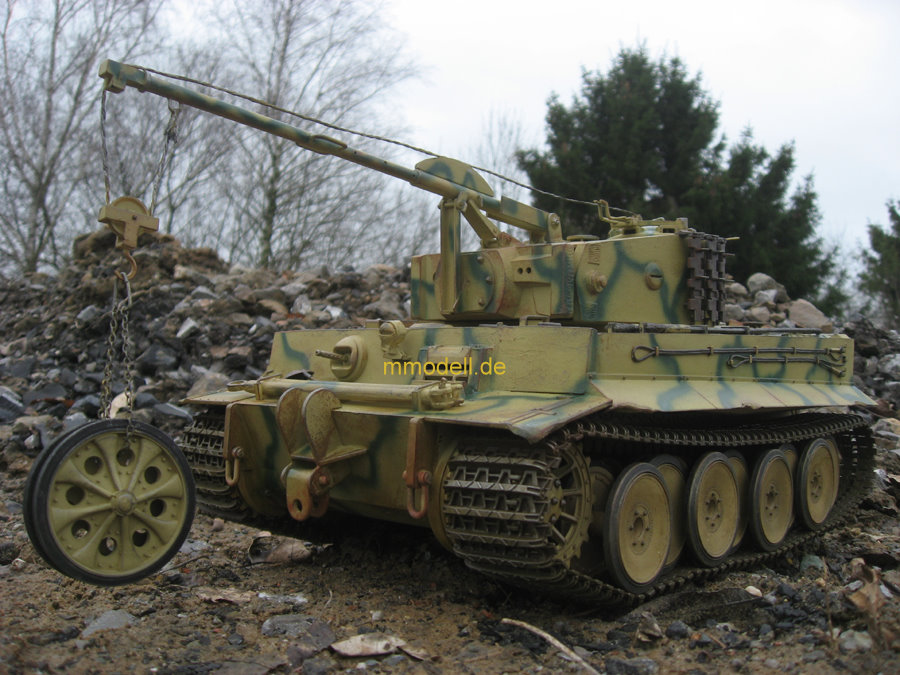
.jpg) Toy model of a Bergetiger | |
| Type | Heavy tank/Military engineering vehicle |
| Place of origin | Nazi Germany |
| Service history | |
| In service | 1943–1945 |
| Used by | Nazi Germany |
| Wars | World War II |
| Production history | |
| Manufacturer | Henschel |
| Specifications (RfRuK VK 4501H Ausf.E, Blatt: G-330) | |
| Mass | 54 tonnes (60 short tons) |
| Length | 6.316 m (20 ft 8.7 in) 8.45 m (27 ft 9 in) gun forward |
| Width | 3.56 m (11 ft 8 in) |
| Height | 3.0 m (9 ft 10 in) |
| Crew | 5 |
| Armor | 25–120 mm (0.98–4.72 in)[1][2] |
Secondary armament | 7.92 mm MG 34 4,500 rounds |
| Engine | Maybach HL230 P45 V-12 700 PS (690 hp, 515 kW) |
| Power/weight | 13 PS/tonne |
| Suspension | Torsion bar |
| Ground clearance | 0.47 m (1 ft 7 in) |
| Fuel capacity | 540 L (140 US gal) including reserve |
Operational range | 110–195 km (68–121 mi) |
| Maximum speed | 45.4 km/h (28.2 mph) |
The Bergetiger was the name the Allied forces gave to a German World War II armored tracked vehicle based on the Tiger. The vehicle was found abandoned on a roadside in Italy with terminal engine problems. The main gun had been removed, and a boom & winch assembly had been fitted to the turret. No other Tiger tanks modified in this manner were ever recovered.
Naming
At the time the vehicle was found it was assumed the vehicle was intended as a tank recovery vehicle. Germans used the "berge" prefix to denote recovery vehicle versions of tanks, such as the "Bergepanther" and "Bergepanzer". Thus the allies dubbed the vehicle they had found the "Bergetiger". No official German name for this vehicle has ever been located.
Dispute over purpose
The Bergetiger's role as a recovery vehicle has been disputed ever since its discovery. The evidence often cited against it being a recovery vehicle is that its crane was not designed to tow the weight of a tank, nor was it equipped with any other common recovery equipment.
A popular alternate theory is that the vehicle was field-modified (possibly after suffering damage to the main gun) as either a mine-clearing vehicle, or to drop explosives to clear battlefield obstacles.
Production numbers
Reports of the number of Bergetigers produced varies. No original German documentation to support these numbers has been located. Some common numbers given are:
- Fifty-eight produced from the factory
- Three produced from the factory
- Three built as "field-expedient" modifications in Italy
- Three built as "field-expedient" modifications and one built from a Tiger damaged while still at the factory.
- Only one built as a "field-expedient" in Italy
References
External links
| Tanks |  | |
|---|---|---|
| Self-propelled artillery | ||
| Assault guns | ||
| Tank destroyers (Panzerjäger, Jagdpanzer) | ||
| Half-tracks | ||
| Armored cars | ||
| Self-propelled anti-aircraft guns | ||
| Demolition vehicles | ||
| Experimental/prototype vehicles | ||
| Proposed designs | ||
| Designations | ||
Content Disclaimer
Informasi ini disarikan dari Wikipedia dan disajikan kembali untuk tujuan edukasi. Konten tersedia di bawah lisensi CC BY-SA 3.0. Kami tidak bertanggung jawab atas ketidakakuratan data yang bersumber dari kontribusi publik tersebut.
- The information displayed on this website is sourced in part or in whole from Wikipedia and has been adapted for the purpose of restating it. We strive to provide accurate and relevant information, however:
- There is no guarantee of absolute accuracy. Wikipedia is an open, collaborative project that can be edited by anyone, so information is subject to change.
- It is not intended to constitute professional advice. The content displayed is for informational and educational purposes only. For important decisions (e.g., medical, legal, or financial), please consult a professional.
- Content copyright. Wikipedia is licensed under the Creative Commons Attribution-ShareAlike License (CC BY-SA). This means that content may be reused with appropriate attribution and shared under a similar license.
- Responsible use. Any risk arising from the use of information from this website is entirely the responsibility of the user.