Borel right process
In the mathematical theory of probability, a Borel right process, named after Émile Borel, is a particular kind of continuous-time random process.
Let be a locally compact, separable, metric space. We denote by the Borel subsets of . Let be the space of right continuous maps from to that have left limits in , and for each , denote by the coordinate map at ; for each , is the value of at . We denote the universal completion of by . For each , let


![{\displaystyle {\mathcal {F}}_{t}=\sigma \left\{X_{s}^{-1}(B):s\in [0,t],B\in {\mathcal {E}}\right\},}](https://wikimedia.org/api/rest_v1/media/math/render/svg/d71e1ce2ca2a456b13dd259d338eeadc41c30ab2)
![{\displaystyle {\mathcal {F}}_{t}^{*}=\sigma \left\{X_{s}^{-1}(B):s\in [0,t],B\in {\mathcal {E}}^{*}\right\},}](https://wikimedia.org/api/rest_v1/media/math/render/svg/b6ad0db6b3f6501bed46d401cc7bd4ff7f5b9a5e)
and then, let


For each Borel measurable function on , define, for each ,


![{\displaystyle U^{\alpha }f(x)=\mathbf {E} ^{x}\left[\int _{0}^{\infty }e^{-\alpha t}f(X_{t})\,dt\right].}](https://wikimedia.org/api/rest_v1/media/math/render/svg/bbcb6bcdfd5b5f17f331d6e0d2f04446c526720e)
Since and the mapping given by is right continuous, we see that for any uniformly continuous function , we have the mapping given by is right continuous.
![{\displaystyle P_{t}f(x)=\mathbf {E} ^{x}\left[f(X_{t})\right]}](https://wikimedia.org/api/rest_v1/media/math/render/svg/b0eb90a16534fa2d55c166366db8e05da8fa67da)


Therefore, together with the monotone class theorem, for any universally measurable function , the mapping given by , is jointly measurable, that is, measurable, and subsequently, the mapping is also -measurable for all finite measures on and on . Here, is the completion of with respect to the product measure . Thus, for any bounded universally measurable function on , the mapping is Lebesgue measurable, and hence, for each , one can define





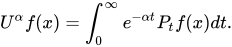
There is enough joint measurability to check that is a Markov resolvent on , which uniquely associated with the Markovian semigroup . Consequently, one may apply Fubini's theorem to see that



![{\displaystyle U^{\alpha }f(x)=\mathbf {E} ^{x}\left[\int _{0}^{\infty }e^{-\alpha t}f(X_{t})dt\right].}](https://wikimedia.org/api/rest_v1/media/math/render/svg/ab11a46f95ce2f2dd0a999488d848b26c8827892)
The following are the defining properties of Borel right processes:[1]
- Hypothesis Droite 1:
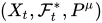
- For each probability measure on , there exists a probability measure on such that is a Markov process with initial measure and transition semigroup .


- Hypothesis Droite 2:
- Let be -excessive for the resolvent on . Then, for each probability measure on , a mapping given by is almost surely right continuous on .


Notes
- ^ Sharpe 1988, Sect. 20
References
- Sharpe, Michael (1988), General Theory of Markov Processes, ISBN 0126390606
Content Disclaimer
Informasi ini disarikan dari Wikipedia dan disajikan kembali untuk tujuan edukasi. Konten tersedia di bawah lisensi CC BY-SA 3.0. Kami tidak bertanggung jawab atas ketidakakuratan data yang bersumber dari kontribusi publik tersebut.
- The information displayed on this website is sourced in part or in whole from Wikipedia and has been adapted for the purpose of restating it. We strive to provide accurate and relevant information, however:
- There is no guarantee of absolute accuracy. Wikipedia is an open, collaborative project that can be edited by anyone, so information is subject to change.
- It is not intended to constitute professional advice. The content displayed is for informational and educational purposes only. For important decisions (e.g., medical, legal, or financial), please consult a professional.
- Content copyright. Wikipedia is licensed under the Creative Commons Attribution-ShareAlike License (CC BY-SA). This means that content may be reused with appropriate attribution and shared under a similar license.
- Responsible use. Any risk arising from the use of information from this website is entirely the responsibility of the user.