Borwein's algorithm
Borwein's algorithm was devised by Jonathan and Peter Borwein to calculate the value of . This and other algorithms can be found in the book Pi and the AGM – A Study in Analytic Number Theory and Computational Complexity.[1]

Ramanujan–Sato series
These two are examples of a Ramanujan–Sato series. The related Chudnovsky algorithm uses a discriminant with class number 1.
Class number 2 (1989)
Start by setting[2]
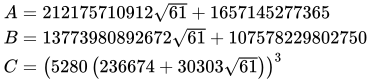
Then

Each additional term of the partial sum yields approximately 25 digits.
Class number 4 (1993)
Start by setting[3]
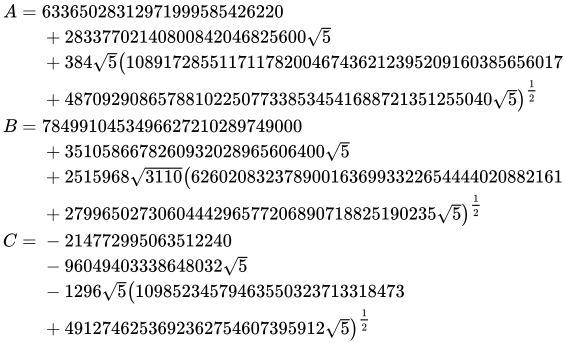
Then
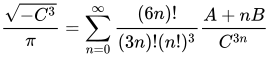
Each additional term of the series yields approximately 50 digits.
Iterative algorithms
Quadratic convergence (1984)
Start by setting[4]
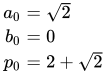
Then iterate
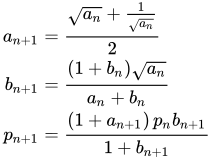
Then pk converges quadratically to π; that is, each iteration approximately doubles the number of correct digits. The algorithm is not self-correcting; each iteration must be performed with the desired number of correct digits for π's final result.
Cubic convergence (1991)
Start by setting
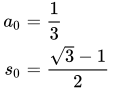
Then iterate
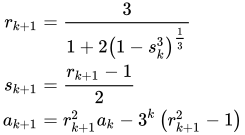
Then ak converges cubically to 1/π; that is, each iteration approximately triples the number of correct digits.
Quartic convergence (1985)
Start by setting[5]
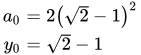
Then iterate
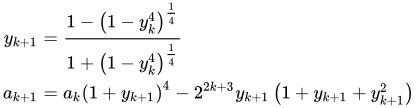
Then ak converges quartically against 1/π; that is, each iteration approximately quadruples the number of correct digits. The algorithm is not self-correcting; each iteration must be performed with the desired number of correct digits for π's final result.
One iteration of this algorithm is equivalent to two iterations of the Gauss–Legendre algorithm. A proof of these algorithms can be found here:[6]
Quintic convergence
Start by setting
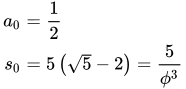
where is the golden ratio. Then iterate

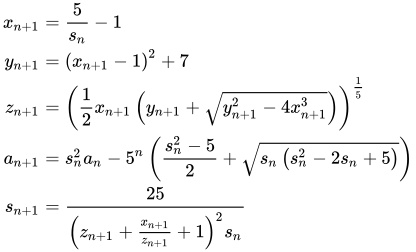
Then ak converges quintically to 1/π (that is, each iteration approximately quintuples the number of correct digits), and the following condition holds:

Nonic convergence
Start by setting
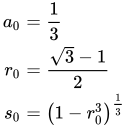
Then iterate
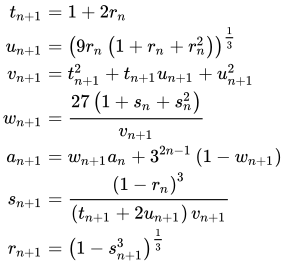
Then ak converges nonically to 1/π; that is, each iteration approximately multiplies the number of correct digits by nine.[7]
See also

References
- ^ Jonathan M. Borwein, Peter B. Borwein, Pi and the AGM – A Study in Analytic Number Theory and Computational Complexity, Wiley, New York, 1987. Many of their results are available in: Jorg Arndt, Christoph Haenel, Pi Unleashed, Springer, Berlin, 2001, ISBN 3-540-66572-2
- ^ Bailey, David H (2023-04-01). "Peter Borwein: A Visionary Mathematician". Notices of the American Mathematical Society. 70 (4): 610–613. doi:10.1090/noti2675. ISSN 0002-9920.
- ^ Borwein, J.M.; Borwein, P.B. (1993). "Class number three Ramanujan type series for 1/π". Journal of Computational and Applied Mathematics. 46 (1–2): 281–290. doi:10.1016/0377-0427(93)90302-R.
- ^ Arndt, Jörg; Haenel, Christoph (1998). π Unleashed. Springer-Verlag. p. 236. ISBN 3-540-66572-2.
- ^ Mak, Ronald (2003). The Java Programmers Guide to Numerical Computation. Pearson Educational. p. 353. ISBN 0-13-046041-9.
- ^ Milla, Lorenz (2019), Easy Proof of Three Recursive π-Algorithms, arXiv:1907.04110
- ^ Henrik Vestermark (4 November 2016). "Practical implementation of π Algorithms" (PDF). Retrieved 29 November 2020.
External links
- Pi Formulas from Wolfram MathWorld
Content Disclaimer
Informasi ini disarikan dari Wikipedia dan disajikan kembali untuk tujuan edukasi. Konten tersedia di bawah lisensi CC BY-SA 3.0. Kami tidak bertanggung jawab atas ketidakakuratan data yang bersumber dari kontribusi publik tersebut.
- The information displayed on this website is sourced in part or in whole from Wikipedia and has been adapted for the purpose of restating it. We strive to provide accurate and relevant information, however:
- There is no guarantee of absolute accuracy. Wikipedia is an open, collaborative project that can be edited by anyone, so information is subject to change.
- It is not intended to constitute professional advice. The content displayed is for informational and educational purposes only. For important decisions (e.g., medical, legal, or financial), please consult a professional.
- Content copyright. Wikipedia is licensed under the Creative Commons Attribution-ShareAlike License (CC BY-SA). This means that content may be reused with appropriate attribution and shared under a similar license.
- Responsible use. Any risk arising from the use of information from this website is entirely the responsibility of the user.