CT Value
CT Values are an important part of calculating disinfectant dosage for the chlorination of drinking water. A CT value is the product of the concentration of a disinfectant (e.g. free chlorine) and the contact time with the water being disinfected. It is typically expressed in units of mg-min/L.
The goal of disinfection is the inactivation of microorganisms. This depends on: the microorganism, the disinfectant being used, the concentration of the disinfectant, the contact time, and the temperature and pH of the water.[1]
Kinetics
The disinfection kinetics are conventionally calculated via the Chick-Watson model, named for the work of Harriette Chick[2] and H. E. Watson.[3] This model is expressed by the following equation:[4]
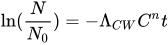
Where:
- is the survival ratio for the microorganisms being killed
- is the Chick-Watson coefficient of specific lethality
- is the concentration of the disinfectant (typically in mg/L)
- is the coefficient of dilution, frequently assumed to be 1[4]
- is the contact time (typically in minutes or seconds)


The survival ratio is commonly expressed as an inactivation ratio (in %) or as the number of reductions in the order of magnitude of the microorganism concentration. For example, a situation where N0=107 CFU/L and N=104 CFU/L would be reported as a 99.9% inactivation or "3-log10" removal.
In water treatment practice, tables of the product C×t are used to calculate disinfection dosages. The calculated CT value is the product of the disinfectant residual (in mg/L) and the detention time (in minutes), through the section at peak hourly flow.[5] These tables express the required CT values to achieve a desired removal of microorganisms of interest in drinking water (e.g. Giardia lamblia cysts) for a given disinfectant under constant temperature and pH conditions. A portion of such a table is reproduced below.
Example CT Table
CT Values for the Inactivation of Giardia Cysts by Free Chlorine at 5 °C and pH ≈ 7.0:[6]
| Chlorine Concentration (mg/L) | 1 log inactivation (mg·L−1·min) | 2 log inactivation (mg·L−1·min) | 3 log inactivation (mg·L−1·min) |
|---|---|---|---|
| 0.6 | 48 | 95 | 143 |
| 1.2 | 51 | 101 | 152 |
| 1.8 | 54 | 108 | 162 |
| 2.4 | 57 | 115 | 172 |
Full tables are much larger than this example and should be obtained from the regulatory agency for a particular jurisdiction.
See also
References
- ^ Pine, Rob; Joe Savage. "Everything You Ever Wanted to Know About CT (and then some)" (PDF). New Mexico Environment Department. Retrieved 20 October 2013.
- ^ Chick, Harriette (January 1908). "An Investigation of the Laws of Disinfection". The Journal of Hygiene. 8 (1): 92–158. doi:10.1017/s0022172400006987. PMC 2167134. PMID 20474353.
- ^ Watson, Herbert Edmeston (1908). "A Note on the Variation of the Rate of Disinfection with Change in the Concentration of the Disinfectant". The Journal of Hygiene. 8 (4): 536–42. doi:10.1017/s0022172400015928. PMC 2167149. PMID 20474372.
- ^ a b MWH (2005). Water Treatment: Principles And Design (2 ed.). Hoboken, NJ: John Wiley & Sons. ISBN 0471110183.
- ^ Office of Drinking Water (1991). Guidance Manual for Compliance with the Filtration and Disinfection Requirements for Public Water Systems Using Surface Water Sources (PDF). United States Environmental Protection Agency.
page 3-20
- ^ Office of Drinking Water (1991). Guidance Manual for Compliance with the Filtration and Disinfection Requirements for Public Water Systems Using Surface Water Sources (PDF). United States Environmental Protection Agency.
Table E-2
External links
- Earth Tech, Inc. (2005). Chlorine and Alternative Disinfectants Guidance Manual (PDF). Manitoba: Manitoba Water Stewardship.
Content Disclaimer
Informasi ini disarikan dari Wikipedia dan disajikan kembali untuk tujuan edukasi. Konten tersedia di bawah lisensi CC BY-SA 3.0. Kami tidak bertanggung jawab atas ketidakakuratan data yang bersumber dari kontribusi publik tersebut.
- The information displayed on this website is sourced in part or in whole from Wikipedia and has been adapted for the purpose of restating it. We strive to provide accurate and relevant information, however:
- There is no guarantee of absolute accuracy. Wikipedia is an open, collaborative project that can be edited by anyone, so information is subject to change.
- It is not intended to constitute professional advice. The content displayed is for informational and educational purposes only. For important decisions (e.g., medical, legal, or financial), please consult a professional.
- Content copyright. Wikipedia is licensed under the Creative Commons Attribution-ShareAlike License (CC BY-SA). This means that content may be reused with appropriate attribution and shared under a similar license.
- Responsible use. Any risk arising from the use of information from this website is entirely the responsibility of the user.