Chain sequence
In the analytic theory of continued fractions, a chain sequence is an infinite sequence {an} of non-negative real numbers chained together with another sequence {gn} of non-negative real numbers by the equations

where either (a) 0 ≤ gn < 1, or (b) 0 < gn ≤ 1. Chain sequences arise in the study of the convergence problem – both in connection with the parabola theorem, and also as part of the theory of positive definite continued fractions.
The infinite continued fraction of Worpitzky's theorem contains a chain sequence. A closely related theorem[1] shows that
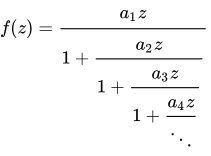
converges uniformly on the closed unit disk |z| ≤ 1 if the coefficients {an} are a chain sequence.
An example
The sequence {1/4, 1/4, 1/4, ...} appears as a limiting case in the statement of Worpitzky's theorem. Since this sequence is generated by setting g0 = g1 = g2 = ... = 1/2, it is clearly a chain sequence. This sequence has two important properties.
- Since f(x) = x − x2 is a maximum when x = 1/2, this example is the "biggest" chain sequence that can be generated with a single generating element; or, more precisely, if {gn} = {x}, and x < 1/2, the resulting sequence {an} will be an endless repetition of a real number y that is less than 1/4.
- The choice gn = 1/2 is not the only set of generators for this particular chain sequence. Notice that setting

- generates the same unending sequence {1/4, 1/4, 1/4, ...}.
Notes
- ^ Wall traces this result back to Oskar Perron (Wall, 1948, p. 48).
References
- H. S. Wall, Analytic Theory of Continued Fractions, D. Van Nostrand Company, Inc., 1948; reprinted by Chelsea Publishing Company, (1973), ISBN 0-8284-0207-8
Content Disclaimer
Informasi ini disarikan dari Wikipedia dan disajikan kembali untuk tujuan edukasi. Konten tersedia di bawah lisensi CC BY-SA 3.0. Kami tidak bertanggung jawab atas ketidakakuratan data yang bersumber dari kontribusi publik tersebut.
- The information displayed on this website is sourced in part or in whole from Wikipedia and has been adapted for the purpose of restating it. We strive to provide accurate and relevant information, however:
- There is no guarantee of absolute accuracy. Wikipedia is an open, collaborative project that can be edited by anyone, so information is subject to change.
- It is not intended to constitute professional advice. The content displayed is for informational and educational purposes only. For important decisions (e.g., medical, legal, or financial), please consult a professional.
- Content copyright. Wikipedia is licensed under the Creative Commons Attribution-ShareAlike License (CC BY-SA). This means that content may be reused with appropriate attribution and shared under a similar license.
- Responsible use. Any risk arising from the use of information from this website is entirely the responsibility of the user.