Clip coordinates
The clip coordinate system is a homogeneous coordinate system in the graphics pipeline that is used for clipping.[1]
Objects' coordinates are transformed via a projection transformation into clip coordinates, at which point it may be efficiently determined on an object-by-object basis which portions of the objects will be visible to the user. In the context of OpenGL or Vulkan, the result of executing vertex processing shaders is considered to be in clip coordinates.[2][3] All coordinates may then be divided by the component of 3D homogeneous coordinates, in what is called the perspective division.

More concretely, a point in clip coordinates is represented with four components,
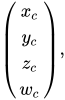
and the following equality defines the relationship between the normalized device coordinates , and and clip coordinates,


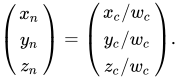
Clip coordinates are convenient for clipping algorithms as points can be checked if their coordinates are outside of the viewing volume. For example, a coordinate for a point is within the viewing volume if it satisfies the inequality .[4] Polygons with vertices outside of the viewing volume may be clipped to fit within the volume.


Clipping algorithms
External links

- Official OpenGL website Archived 2011-02-26 at the Wayback Machine
References
- ^ Dave Shreiner; OpenGL Architecture Review Board (2006). OpenGL programming guide: the official guide to learning OpenGL, version 2. Addison-Wesley. ISBN 978-0-321-33573-9. Retrieved 29 December 2011.
- ^ Segal, Mark; Akeley, Kurt (May 14, 2018). "OpenGL 4.6 Core Profile" (PDF). The Khronos Group.
- ^ The Khronos® Vulkan Working Group (January 13, 2019). "Vulkan® 1.0.98 - A Specification". The Khronos Group. Retrieved January 23, 2019.
- ^ "Vertex Post-Processing". The Khronos Group. Retrieved January 23, 2019.
 | This computer graphics–related article is a stub. You can help Wikipedia by adding missing information. |
Content Disclaimer
Informasi ini disarikan dari Wikipedia dan disajikan kembali untuk tujuan edukasi. Konten tersedia di bawah lisensi CC BY-SA 3.0. Kami tidak bertanggung jawab atas ketidakakuratan data yang bersumber dari kontribusi publik tersebut.
- The information displayed on this website is sourced in part or in whole from Wikipedia and has been adapted for the purpose of restating it. We strive to provide accurate and relevant information, however:
- There is no guarantee of absolute accuracy. Wikipedia is an open, collaborative project that can be edited by anyone, so information is subject to change.
- It is not intended to constitute professional advice. The content displayed is for informational and educational purposes only. For important decisions (e.g., medical, legal, or financial), please consult a professional.
- Content copyright. Wikipedia is licensed under the Creative Commons Attribution-ShareAlike License (CC BY-SA). This means that content may be reused with appropriate attribution and shared under a similar license.
- Responsible use. Any risk arising from the use of information from this website is entirely the responsibility of the user.