Clock angle problem
 | This article needs more citations. (November 2014) |

Clock angle problems are a type of mathematical problem which involve finding the angle between the hands of an analog clock.
Math problem
Clock angle problems relate two different measurements: angles and time. The angle is typically measured in degrees from the mark of number 12 clockwise. The time is usually based on a 12-hour clock.
A method to solve such problems is to consider the rate of change of the angle in degrees per minute. The hour hand of a normal 12-hour analogue clock turns 360° in 12 hours (720 minutes) or 0.5° per minute. The minute hand rotates through 360° in 60 minutes or 6° per minute.[1]
Equation for the angle of the hour hand

where:
- θ is the angle in degrees of the hand measured clockwise from the 12
- H is the hour.
- M is the minutes past the hour.
- MΣ is the number of minutes since 12 o'clock.

Equation for the angle of the minute hand

where:
- θ is the angle in degrees of the hand measured clockwise from the 12 o'clock position.
- M is the minute.
Example
The time is 2:20. The angle in degrees of the hour hand is:

The angle in degrees of the minute hand is:

Equation for the angle between the hands
The angle between the hands can be found using the following formula:
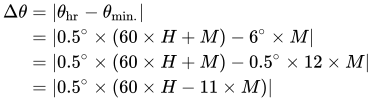
where
- H is the hour
- M is the minute
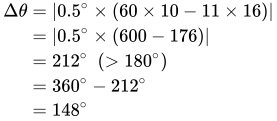
If the angle is greater than 180 degrees then subtract it from 360 degrees.
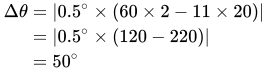
Example 1
The time is 2:20.
Example 2
The time is 10:16.
When are the hour and minute hands of a clock superimposed?
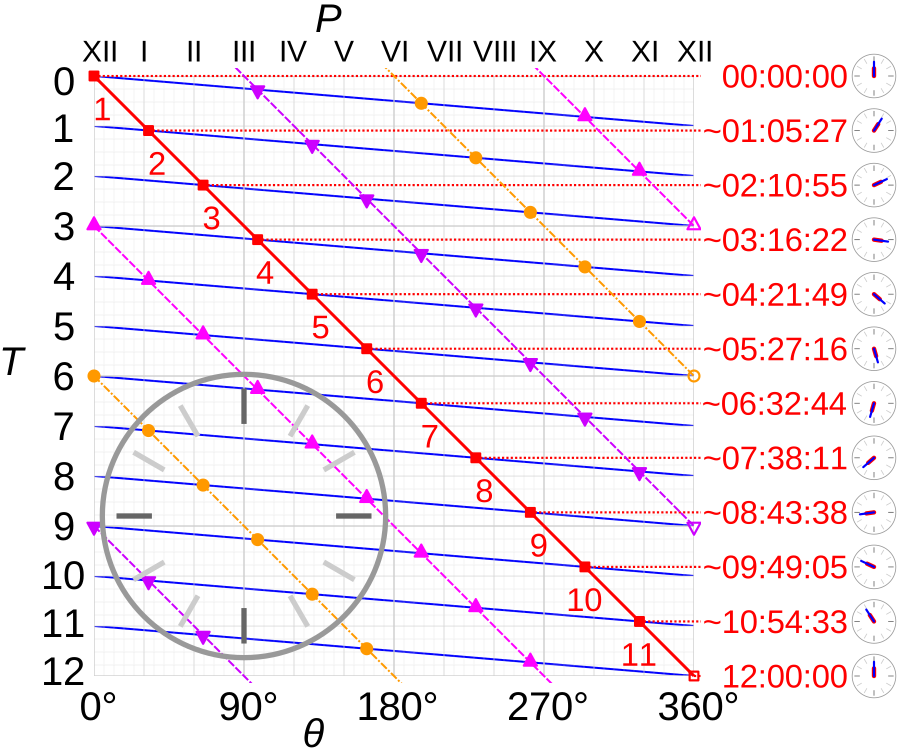
The hour and minute hands are superimposed only when their angle is the same.
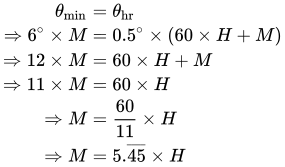
H is an integer in the range 0–11. This gives times of: 0:00, 1:05.45, 2:10.90, 3:16.36, 4:21.81, 5:27.27. 6:32.72, 7:38.18, 8:43.63, 9:49.09, 10:54.54, and 12:00. (0.45 minutes are exactly 27.27 seconds.)
See also
References
External links
Content Disclaimer
Informasi ini disarikan dari Wikipedia dan disajikan kembali untuk tujuan edukasi. Konten tersedia di bawah lisensi CC BY-SA 3.0. Kami tidak bertanggung jawab atas ketidakakuratan data yang bersumber dari kontribusi publik tersebut.
- The information displayed on this website is sourced in part or in whole from Wikipedia and has been adapted for the purpose of restating it. We strive to provide accurate and relevant information, however:
- There is no guarantee of absolute accuracy. Wikipedia is an open, collaborative project that can be edited by anyone, so information is subject to change.
- It is not intended to constitute professional advice. The content displayed is for informational and educational purposes only. For important decisions (e.g., medical, legal, or financial), please consult a professional.
- Content copyright. Wikipedia is licensed under the Creative Commons Attribution-ShareAlike License (CC BY-SA). This means that content may be reused with appropriate attribution and shared under a similar license.
- Responsible use. Any risk arising from the use of information from this website is entirely the responsibility of the user.