Concavification
In mathematics, concavification is the process of converting a non-concave function to a concave function. A related concept is convexification – converting a non-convex function to a convex function. It is especially important in economics and mathematical optimization.[1]
Concavification of a quasiconcave function by monotone transformation
An important special case of concavification is where the original function is a quasiconcave function. It is known that:
- Every concave function is quasiconcave, but the opposite is not true.
- Every monotone transformation of a quasiconcave function is also quasiconcave. For example, if is quasiconcave and is a monotonically-increasing function, then is also quasiconcave.


Therefore, a natural question is: given a quasiconcave function , does there exist a monotonically increasing such that is concave?
Example and Counter Example
As an example, consider the function on the domain . This function is quasiconcave, but it is not concave (in fact, it is strictly convex). It can be concavified, for example, using the monotone transformation , since is concave.
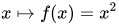

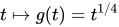

Not every concave function can be concavified in this way. A counter example was shown by Fenchel.[2] His example is: . Fenchel proved that this function is quasiconcave, but there is no monotone transformation such that is concave.[3]: 7–9


Based on these examples, we define a function to be concavifiable if there exists a monotone transformation that makes it concave. The question now becomes: what quasiconcave functions are concavifiable?
Concavifiability
Yakar Kannai treats the question in depth in the context of utility functions, giving sufficient conditions under which continuous convex preferences can be represented by concave utility functions.[4]
His results were later generalized by Connell and Rasmussen,[3] who give necessary and sufficient conditions for concavifiability. They show that the function violates their conditions and thus is not concavifiable. They prove that this function is strictly quasiconcave and its gradient is non-vanishing, but it is not concavifiable.

References
- ^ Li, D.; Sun, X. L.; Biswal, M. P.; Gao, F. (2001-07-01). "Convexification, Concavification and Monotonization in Global Optimization". Annals of Operations Research. 105 (1–4): 213–226. doi:10.1023/A:1013313901854. ISSN 0254-5330. S2CID 7570136.
- ^ Fenchel (1953). Convex cones, sets and functions. Princeton University.
- ^ a b Connell, Christopher; Rasmusen, Eric Bennett (December 2017). "Concavifying the QuasiConcave". Journal of Convex Analysis. 24 (4): 1239–1262.
- ^ Kannai, Yakar (1977-03-01). "Concavifiability and constructions of concave utility functions". Journal of Mathematical Economics. 4 (1): 1–56. doi:10.1016/0304-4068(77)90015-5. ISSN 0304-4068.
Content Disclaimer
Informasi ini disarikan dari Wikipedia dan disajikan kembali untuk tujuan edukasi. Konten tersedia di bawah lisensi CC BY-SA 3.0. Kami tidak bertanggung jawab atas ketidakakuratan data yang bersumber dari kontribusi publik tersebut.
- The information displayed on this website is sourced in part or in whole from Wikipedia and has been adapted for the purpose of restating it. We strive to provide accurate and relevant information, however:
- There is no guarantee of absolute accuracy. Wikipedia is an open, collaborative project that can be edited by anyone, so information is subject to change.
- It is not intended to constitute professional advice. The content displayed is for informational and educational purposes only. For important decisions (e.g., medical, legal, or financial), please consult a professional.
- Content copyright. Wikipedia is licensed under the Creative Commons Attribution-ShareAlike License (CC BY-SA). This means that content may be reused with appropriate attribution and shared under a similar license.
- Responsible use. Any risk arising from the use of information from this website is entirely the responsibility of the user.