Congruence coefficient
In multivariate statistics, the congruence coefficient is an index of the similarity between factors that have been derived in a factor analysis. It was introduced in 1948 by Cyril Burt who referred to it as unadjusted correlation. It is also called Tucker's congruence coefficient after Ledyard Tucker who popularized the technique. Its values range between -1 and +1. It can be used to study the similarity of extracted factors across different samples of, for example, test takers who have taken the same test.[1][2][3]
Definition
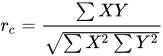
Let X and Y be column vectors of factor loadings for two different samples. The formula for the congruence coefficient, or rc, is then[2]
Interpretation
Generally, a congruence coefficient of 0.90 is interpreted as indicating a high degree of factor similarity, while a coefficient of 0.95 or higher indicates that the factors are virtually identical. Alternatively, a value in the range 0.85–0.94 has been seen as corresponding to a fair similarity, with values higher than 0.95 indicating that the factors can be considered to be equal.[1][2]
The congruence coefficient can also be defined as the cosine of the angle between factor axes based on the same set of variables (e.g., tests) obtained for two samples (see Cosine similarity). For example, with perfect congruence the angle between the factor axes is 0 degrees, and the cosine of 0 is 1.[2]
Comparison with Pearson's r
The congruence coefficient is preferred to Pearson's r as a measure of factor similarity, because the latter may produce misleading results. The computation of the congruence coefficient is based on the deviations of factor loadings from zero, whereas r is based on the deviations from the mean of the factor loadings.[2]
See also
References
- ^ a b Lorenzo-Seva, U. & ten Berge, J.M.F. (2006). Tucker’s Congruence Coefficient as a Meaningful Index of Factor Similarity. Methodology, 2, 57–64.
- ^ a b c d e Jensen, A.R. (1998). The g factor: The science of mental ability. Westport, CT: Praeger, pp. 99–100.
- ^ Abdi, H. (2007). RV Coefficient and Congruence Coefficient. In Neil Salkind (Ed.), Encyclopedia of Measurement and Statistics. Thousand Oaks (CA): Sage.
Content Disclaimer
Informasi ini disarikan dari Wikipedia dan disajikan kembali untuk tujuan edukasi. Konten tersedia di bawah lisensi CC BY-SA 3.0. Kami tidak bertanggung jawab atas ketidakakuratan data yang bersumber dari kontribusi publik tersebut.
- The information displayed on this website is sourced in part or in whole from Wikipedia and has been adapted for the purpose of restating it. We strive to provide accurate and relevant information, however:
- There is no guarantee of absolute accuracy. Wikipedia is an open, collaborative project that can be edited by anyone, so information is subject to change.
- It is not intended to constitute professional advice. The content displayed is for informational and educational purposes only. For important decisions (e.g., medical, legal, or financial), please consult a professional.
- Content copyright. Wikipedia is licensed under the Creative Commons Attribution-ShareAlike License (CC BY-SA). This means that content may be reused with appropriate attribution and shared under a similar license.
- Responsible use. Any risk arising from the use of information from this website is entirely the responsibility of the user.