Control volume
| Thermodynamics |
|---|
 |






In continuum mechanics and thermodynamics, a control volume (CV) is a mathematical abstraction employed in the process of creating mathematical models of physical processes. In an inertial frame of reference, it is a fictitious region of a given volume fixed in space or moving with constant flow velocity through which the continuuum (a continuous medium such as gas, liquid or solid) flows. The closed surface enclosing the region is referred to as the control surface.[1]
At steady state, a control volume can be thought of as an arbitrary volume in which the mass of the continuum remains constant. As a continuum moves through the control volume, the mass entering the control volume is equal to the mass leaving the control volume. At steady state, and in the absence of work and heat transfer, the energy within the control volume remains constant. It is analogous to the classical mechanics concept of the free body diagram.
Overview
Typically, to understand how a given physical law applies to the system under consideration, one first begins by considering how it applies to a small, control volume, or "representative volume". There is nothing special about a particular control volume, it simply represents a small part of the system to which physical laws can be easily applied. This gives rise to what is termed a volumetric, or volume-wise formulation of the mathematical model.
One can then argue that since the physical laws behave in a certain way on a particular control volume, they behave the same way on all such volumes, since that particular control volume was not special in any way. In this way, the corresponding point-wise formulation of the mathematical model can be developed so it can describe the physical behaviour of an entire (and maybe more complex) system.
In continuum mechanics the conservation equations (for instance, the Navier-Stokes equations) are in integral form. They therefore apply on volumes. Finding forms of the equation that are independent of the control volumes allows simplification of the integral signs. The control volumes can be stationary or they can move with an arbitrary velocity.[2]
Substantive derivative
Computations in continuum mechanics often require that the regular time derivation operator is replaced by the substantive derivative operator . This can be seen as follows.


Consider a bug that is moving through a volume where there is some scalar, e.g. pressure, that varies with time and position: .

If the bug during the time interval from to moves from to then the bug experiences a change in the scalar value,





(the total differential). If the bug is moving with a velocity the change in particle position is and we may write


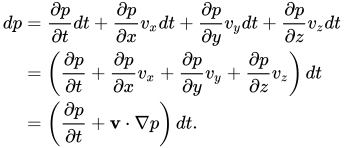
where is the gradient of the scalar field p. So:

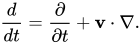
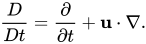
If the bug is just moving with the flow, the same formula applies, but now the velocity vector,v, is that of the flow, u. The last parenthesized expression is the substantive derivative of the scalar pressure. Since the pressure p in this computation is an arbitrary scalar field, we may abstract it and write the substantive derivative operator as
See also
References
- James R. Welty, Charles E. Wicks, Robert E. Wilson & Gregory Rorrer Fundamentals of Momentum, Heat, and Mass Transfer ISBN 0-471-38149-7
Notes
- ^ G.J. Van Wylen and R.E. Sonntag (1985), Fundamentals of Classical Thermodynamics, Section 2.1 (3rd edition), John Wiley & Sons, Inc., New York ISBN 0-471-82933-1
- ^ Nangia, Nishant; Johansen, Hans; Patankar, Neelesh A.; Bhalla, Amneet Pal S. (2017). "A moving control volume approach to computing hydrodynamic forces and torques on immersed bodies". Journal of Computational Physics. 347: 437–462. arXiv:1704.00239. Bibcode:2017JCoPh.347..437N. doi:10.1016/j.jcp.2017.06.047. S2CID 37560541.
External links
PDFs
Content Disclaimer
Informasi ini disarikan dari Wikipedia dan disajikan kembali untuk tujuan edukasi. Konten tersedia di bawah lisensi CC BY-SA 3.0. Kami tidak bertanggung jawab atas ketidakakuratan data yang bersumber dari kontribusi publik tersebut.
- The information displayed on this website is sourced in part or in whole from Wikipedia and has been adapted for the purpose of restating it. We strive to provide accurate and relevant information, however:
- There is no guarantee of absolute accuracy. Wikipedia is an open, collaborative project that can be edited by anyone, so information is subject to change.
- It is not intended to constitute professional advice. The content displayed is for informational and educational purposes only. For important decisions (e.g., medical, legal, or financial), please consult a professional.
- Content copyright. Wikipedia is licensed under the Creative Commons Attribution-ShareAlike License (CC BY-SA). This means that content may be reused with appropriate attribution and shared under a similar license.
- Responsible use. Any risk arising from the use of information from this website is entirely the responsibility of the user.