Cosheaf
In topology, a branch of mathematics, a cosheaf is a dual notion to that of a sheaf that is useful in studying Borel-Moore homology.[further explanation needed]
Definition
We associate to a topological space its category of open sets , whose objects are the open sets of , with a (unique) morphism from to whenever . Fix a category . Then a precosheaf (with values in ) is a covariant functor , i.e., consists of


- for each open set of , an object in , and
- for each inclusion of open sets , a morphism in such that
- for all and
- whenever .


Suppose now that is an abelian category that admits small colimits. Then a cosheaf is a precosheaf for which the sequence

is exact for every collection of open sets, where and . (Notice that this is dual to the sheaf condition.) Approximately, exactness at means that every element over can be represented as a finite sum of elements that live over the smaller opens , while exactness at means that, when we compare two such representations of the same element, their difference must be captured by a finite collection of elements living over the intersections .





Equivalently, is a cosheaf if
- for all open sets and , is the pushout of and , and
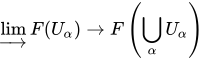
- for any upward-directed family of open sets, the canonical morphism is an isomorphism. One can show that this definition agrees with the previous one.[1] This one, however, has the benefit of making sense even when is not an abelian category.



Examples
A motivating example of a precosheaf of abelian groups is the singular precosheaf, sending an open set to , the free abelian group of singular -chains on . In particular, there is a natural inclusion whenever . However, this fails to be a cosheaf because a singular simplex cannot be broken up into smaller pieces. To fix this, we let be the barycentric subdivision homomorphism and define to be the colimit of the diagram


In the colimit, a simplex is identified with all of its barycentric subdivisions. One can show using the Lebesgue number lemma that the precosheaf sending to is in fact a cosheaf.
Fix a continuous map of topological spaces. Then the precosheaf (on ) of topological spaces sending to is a cosheaf.[2]


Notes
- ^ Bredon, Glen E. (24 January 1997). Sheaf Theory. Springer. ISBN 9780387949055.
- ^ Lurie, Jacob. "Tamagawa Numbers via Nonabelian Poincare Duality, Lecture 9: Nonabelian Poincare Duality in Algebraic Geometry" (PDF). School of Mathematics, Institute for Advanced Study.
References
- Bredon, Glen E. (24 January 1997). Sheaf Theory. Springer. ISBN 9780387949055.
- Bredon, Glen (1968). "Cosheaves and homology". Pacific Journal of Mathematics. 25: 1–32. doi:10.2140/pjm.1968.25.1.
- Funk, J. (1995). "The display locale of a cosheaf". Cahiers de Topologie et Géométrie Différentielle Catégoriques. 36 (1): 53–93.
- Curry, Justin Michael (2015). "Topological data analysis and cosheaves". Japan Journal of Industrial and Applied Mathematics. 32 (2): 333–371. arXiv:1411.0613. doi:10.1007/s13160-015-0173-9. S2CID 256048254.
- Positselski, Leonid (2012). "Contraherent cosheaves". arXiv:1209.2995 [math.CT].
- Rosiak, Daniel (25 October 2022). Sheaf Theory through Examples. MIT Press. ISBN 9780262362375.
- Lurie, Jacob. "Tamagawa Numbers via Nonabelian Poincare Duality, Lecture 8: Nonabelian Poincare Duality in Topology" (PDF). School of Mathematics, Institute for Advanced Study.
- Curry, Justin (2014). "§ 3, in particular Thm 3.10". Sheaves, cosheaves and applications (Doctoral dissertation). University of Pennsylvania. p. 34. arXiv:1303.3255. ProQuest 1553207954.
 | This topology-related article is a stub. You can help Wikipedia by adding missing information. |
Content Disclaimer
Informasi ini disarikan dari Wikipedia dan disajikan kembali untuk tujuan edukasi. Konten tersedia di bawah lisensi CC BY-SA 3.0. Kami tidak bertanggung jawab atas ketidakakuratan data yang bersumber dari kontribusi publik tersebut.
- The information displayed on this website is sourced in part or in whole from Wikipedia and has been adapted for the purpose of restating it. We strive to provide accurate and relevant information, however:
- There is no guarantee of absolute accuracy. Wikipedia is an open, collaborative project that can be edited by anyone, so information is subject to change.
- It is not intended to constitute professional advice. The content displayed is for informational and educational purposes only. For important decisions (e.g., medical, legal, or financial), please consult a professional.
- Content copyright. Wikipedia is licensed under the Creative Commons Attribution-ShareAlike License (CC BY-SA). This means that content may be reused with appropriate attribution and shared under a similar license.
- Responsible use. Any risk arising from the use of information from this website is entirely the responsibility of the user.