Deslanges trisectrix

The Deslanges trisectrix (sometimes also spelled Delanges) is a curve belonging to the family of Deslanges sectrices, named after the Italian engineer and mathematician Paolo Deslanges (c. 1750–1810), who studied them in 1783.[1] Like other trisectrix curves, it can be used as an auxiliary tool to perform angle trisection with a straightedge and compass, although the use of such auxiliary tools is outside the admissible methods of classical geometry.
Geometric definition

The geometric construction of the Deslanges trisectrix is based on a circle centered at the origin O, such that the points of the trisectrix form the locus determined by the intersection of two families of lines:
- Radial lines from the origin forming an angle of with the x-axis.
- Horizontal lines drawn from the intersection points of the circle and rays forming an angle of with the x-axis.


According to the diagram,[1] to determine a point P, two radii are drawn: OP1 (at angle ) and OP2 (at angle ). From point P1 (the intersection of the first radius and the circle), a line parallel to the x-axis is drawn, which intersects the ray OP2 at point P.
Equations
According to the geometric definition, the polar equation is of the form:
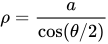
An equivalent form of the equation in polar coordinates uses the secant function to write the expression compactly:[2] (where is a parameter to orient the curve with respect to the origin of the angles).


In Cartesian coordinates, the equation of the trisectrix is of the form:[1]

Properties
The Deslanges trisectrix and the folium of Dürer are inverse curves to each other with respect to any circle centered at the common center of symmetry of both curves.
Trisection

To determine the trisection of an arbitrary angle , the following construction can be used:
- Draw the circle tangent to the interior of the trisectrix, centered at O with radius a.
- Draw the radius forming an angle of counterclockwise from the positive x-axis, which determines point P2 on the circle.
- Draw the tangent to the circle at P2, which intersects the trisectrix at point P1.
- The angle P1OP2 measures .

Deslanges sectrices
Generalizing the trisectrix formula for a value other than 2 yields the following expression:[1]

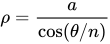
from which Deslanges sectrices of order (for integer ) can be generated.

Gallery
 |
 |
See also
References
- ^ a b c d "DELANGES TRISECTRIX AND SECTRIX". mathcurve. Retrieved March 17, 2021.
- ^ Daniel J. Velleman; S. Wagon (2020). Bicycle or Unicycle?: A Collection of Intriguing Mathematical Puzzles. American Mathematical Soc. p. 86. ISBN 9781470447595. Retrieved March 17, 2021.
External links

- "DELANGES TRISECTRIX AND SECTRIX". mathcurve. Retrieved March 17, 2021.
Content Disclaimer
Informasi ini disarikan dari Wikipedia dan disajikan kembali untuk tujuan edukasi. Konten tersedia di bawah lisensi CC BY-SA 3.0. Kami tidak bertanggung jawab atas ketidakakuratan data yang bersumber dari kontribusi publik tersebut.
- The information displayed on this website is sourced in part or in whole from Wikipedia and has been adapted for the purpose of restating it. We strive to provide accurate and relevant information, however:
- There is no guarantee of absolute accuracy. Wikipedia is an open, collaborative project that can be edited by anyone, so information is subject to change.
- It is not intended to constitute professional advice. The content displayed is for informational and educational purposes only. For important decisions (e.g., medical, legal, or financial), please consult a professional.
- Content copyright. Wikipedia is licensed under the Creative Commons Attribution-ShareAlike License (CC BY-SA). This means that content may be reused with appropriate attribution and shared under a similar license.
- Responsible use. Any risk arising from the use of information from this website is entirely the responsibility of the user.