Draft:AC Method (2)
 | Draft article not currently submitted for review.
This is a draft Articles for creation (AfC) submission. It is not currently pending review. While there are no deadlines, abandoned drafts may be deleted after six months. To edit or make changes to this draft, simply click on the "Edit" tab at the top of the window. To be accepted, a draft should:
It is strongly discouraged to write about either yourself or your business or employer. If you do so, you must declare it. Where to get help
How to improve a draft
You can also browse Wikipedia:Featured articles and Wikipedia:Good articles to find examples of Wikipedia's best writing on topics similar to your proposed article. Improving your odds of a speedy review To improve your odds of a faster review, tag your draft with relevant WikiProject tags using the button below. This will let reviewers know a new draft has been submitted in their area of interest. For instance, if you wrote about a female astronomer, you would want to add the Biography, Astronomy, and Women scientists tags. Editor resources
Last edited by JJMC89 bot (talk | contribs) 4 months ago. (Update) |
 Comment: Reference "Final Exam Review: Intermediate Algebra" blatantly fails verification, other references unchecked. fifteen thousand two hundred twenty four (talk) 01:42, 9 April 2026 (UTC)

 | This article may incorporate text from a large language model, which is prohibited in Wikipedia articles. (April 2026) |
In elementary algebra, the AC method (also called the ac-grouping method or simply factoring by grouping) is a technique for factoring quadratic trinomials of the form
| 1 |

where the leading coefficient is not equal to 1.[1][2] The method is a systematic way of rewriting the middle term as a sum of two terms whose coefficients have a product equal to and a sum equal to ; the resulting four‑term polynomial is then factored by grouping.[3][4]


History
The exact origins of the AC method are unclear, but it has been a standard fixture in American algebra textbooks since at least the late 20th century. The method is closely related to the technique of factoring by grouping, which appears in elementary algebra texts as early as the 19th century.[3]
The name «AC method» derives from the first step of the process: computing the product ac (the product of the leading coefficient and the constant term).[1] Some textbooks refer to it as the «ac‑grouping method» because it combines the multiplication step with the grouping technique.[1]
The method became widely used in high school and college algebra curricula during the 1990s and 2000s as a systematic alternative to trial‑and‑error factoring.[1][4][3][2]
Description
The AC method is a systematic procedure for factoring quadratic trinomials of the form (with a ≠ 0) by transforming them into four‑term polynomials that can be factored by grouping.[1][4]
The algorithm consists of the following steps:[3][2]
- Compute the product ac, i.e., multiply the leading coefficient a by the constant term c.[1]
- Find two integers p and q such that and p + q = b.[3] If no such integers exist, the trinomial does not factor over the integers.[2]
- Rewrite the middle term bx as the sum of two terms using p and q: . The original trinomial becomes a four‑term polynomial: .[1]


Factor by grouping:
- Group the first two terms and the last two terms: ;[4]
- Factor out the greatest common factor (GCF) from each group;
- If the two groups contain a common binomial factor, factor it out to obtain the product of two binomials.[4]

Verify the factorization by multiplying the binomials using the FOIL method; the result should equal the original trinomial.[2]
The following example demonstrates the AC method.
Example. Factor

- Identify the coefficients: a = 2, b = -11, c = 5;
- Compute
- Find two numbers whose product is 10 and whose sum is -11. The numbers -10 and -1 satisfy and
- Rewrite the middle term:
- Group:
- Factor each group:
- Factor out the common binomial (x - 5):
- Check by multiplication: , which matches the original trinomial.


Thus, .

Examples
The following examples illustrate the application of the AC method in different situations.
Factoring a trinomial with a negative ac
Factor .[1]

- Identify the coefficients: a = 2, b = 5, c = -12
- Compute
- Find two numbers whose product is -24 and whose sum is 5. The numbers 8 and -3 satisfy and
- Rewrite the middle term:
- Group:
- Factor each group:
- Factor out the common binomial (x + 4):


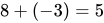


Thus, .

Factoring a trinomial with a common factor
Factor [2]

- First, factor out the greatest common factor (GCF) of all terms, which is 2:
- Now factor the inner trinomial using the AC method
- For : a = 2, b = -1, c = -3
- Compute
- Find two numbers whose product is -6 and whose sum is -1. The numbers -3 and 2 satisfy and
- Rewrite the middle term:
- Group:
- Factor each group:
- Factor out the common binomial (2x - 3):
- Include the GCF factored out initially:





Thus, .

A trinomial that does not factor over the integers
Factor .[3]

- Identify the coefficients: a = 1, b = 1, c = 1
- Compute
- Find two integers whose product is 1 and whose sum is 1. The only integer pairs whose product is 1 are (1, 1) and (-1, -1). Their sums are 2 and -2 respectively, neither of which equals 1.
- Since no such integers exist, the trinomial does not factor over the integers.[2]

Why it works
The AC method can be justified by examining the structure of a quadratic trinomial that factors over the integers. Suppose that the trinomial (with a ≠ 0) factors as
| 2 |

where r, s, t, u are integers and r ≠ 0, t ≠ 0. Expanding the right‑hand side gives
| 3 |

From these relations, the product ac can be expressed as
| 5 |

Thus the two numbers ru and st have the following properties:
- Their product is ;
- Their sum is .


These are precisely the two numbers p and q sought in the AC method: p = ru and q = st.[3]
Once p and q are found, the original trinomial can be rewritten as
| 6 |

Substituting a = rt, p = ru, q = st, and c = su yields
| 7 |

Grouping the first two terms and the last two terms gives
| 8 |

which is exactly the original factorization.[1]
If no integers p and q satisfy pq = ac and p + q = b, then the trinomial cannot factor over the integers, as there would be no way to split the middle term to allow grouping into integer factors.[2]
Comparison with other methods
Several techniques exist for factoring quadratic trinomials. The AC method is one systematic approach; its strengths and weaknesses can be understood by comparing it to alternative methods.
- Trial and error (or guess and check) is the most basic method. The student attempts to find binomial factors by testing combinations of integers r, t, s, u that satisfy rt = a and su = c, and then checks whether the resulting middle coefficient ru + st equals b.[3] This method relies on intuition and can become tedious when a and c have many factor pairs. The AC method replaces guesswork with a systematic search for two numbers whose product is ac and sum is b, making it more reliable for students who struggle with trial and error.[2]
- The quadratic formula provides a universal way to factor any quadratic polynomial over the real or complex numbers. If the equation has roots and (found by , then the polynomial factors as . This method always works, even when the roots are irrational or complex, but it requires computation of the discriminant and handling of radicals. For integer factorization, the quadratic formula is often more computationally heavy than necessary.[1]
- The AC method is a specialized application of factoring by grouping. Grouping itself is a more general technique applicable to polynomials of any degree, but for a quadratic trinomial the AC method provides a concrete rule for splitting the middle term.[1] Once the middle term is split, the remaining grouping step is identical to that used for higher‑degree polynomials.




Limitations
The AC method has several limitations:[2][3]
- It is designed specifically for quadratic trinomials of the form . Polynomials of higher degree cannot be factored directly by this method unless they can be reduced to a quadratic through substitution.
- The method assumes that the coefficients a, b, c are integers (or can be made integers by factoring out a common denominator). If they are irrational, the search for integer p and q is meaningless.
- It works only when the trinomial factors over the integers. If the discriminant b^2 - 4ac is not a perfect square, no integers p, q with the required properties exist, and the method correctly indicates that the polynomial is prime over Z[x].[2]
- For large values of ac, the enumeration of factor pairs can still be time‑consuming, although it is more systematic than random guessing. In such cases, the quadratic formula or computer algebra systems may be more efficient.
Notes
- ^ a b c d e f g h i j k Kime, Linda Almgren; Clark, Judith; Michael, Beverly K. (2017). Explorations in College Algebra. John Wiley & Sons. p. 469. ISBN 978-1-119-39297-2.
- ^ a b c d e f g h i j k Wong, Bobson; Bukalov, Larisa; Slavin, Steve (2022). Practical Algebra: A Self-Teaching Guide. John Wiley & Sons. p. 265. ISBN 978-1-119-71541-2.
- ^ a b c d e f g h i Frempong, A. A. (2012). Intermediate Algebra. microtextbooksdotcom. p. 44. ISBN 978-1-884306-77-8.
- ^ a b c d e Buthusiem, Gregory; Toth, Gabor (2020). Precalculus. Linus Learning. p. 21. ISBN 978-1-60797-798-8.
Content Disclaimer
Informasi ini disarikan dari Wikipedia dan disajikan kembali untuk tujuan edukasi. Konten tersedia di bawah lisensi CC BY-SA 3.0. Kami tidak bertanggung jawab atas ketidakakuratan data yang bersumber dari kontribusi publik tersebut.
- The information displayed on this website is sourced in part or in whole from Wikipedia and has been adapted for the purpose of restating it. We strive to provide accurate and relevant information, however:
- There is no guarantee of absolute accuracy. Wikipedia is an open, collaborative project that can be edited by anyone, so information is subject to change.
- It is not intended to constitute professional advice. The content displayed is for informational and educational purposes only. For important decisions (e.g., medical, legal, or financial), please consult a professional.
- Content copyright. Wikipedia is licensed under the Creative Commons Attribution-ShareAlike License (CC BY-SA). This means that content may be reused with appropriate attribution and shared under a similar license.
- Responsible use. Any risk arising from the use of information from this website is entirely the responsibility of the user.