Draft:Elo In Chess
Submission rejected on 21 June 2026 by ChrysGalley (talk). The subject does not meet Wikipedia's criteria for inclusion. Rejected by ChrysGalley 56 days ago. Last edited by 331dot 56 days ago. |  |
Submission declined by ChrysGalley (talk). This draft does not include any sources or inline citations. Wikipedia's verifiability policy requires that all content be supported by reliable sources. You should also use inline citations (footnotes) to show which source supports which specific statement.
Declined by ChrysGalley.The draft requires multiple published secondary sources that:
Please add references that meet all three of these criteria. If none exist, the subject is not yet suitable for Wikipedia. You must place an inline citation directly after:
Learn how to create inline citations in the:
|  |
Submission declined by ScalarFactor (talk). This draft appears to contain text generated by a large language model (such as ChatGPT). You cannot use LLMs to generate article content.
LLM-generated pages with certain obvious signs of being machine generated may be deleted without notice. Instead, only summarize in your own words a range of independent, reliable, published sources that discuss the subject. See the advice page on large language models for more information.This draft does not include any sources or inline citations. Wikipedia's verifiability policy requires that all content be supported by reliable sources. You should also use inline citations (footnotes) to show which source supports which specific statement.
Declined by ScalarFactor.The draft requires multiple published secondary sources that:
Please add references that meet all three of these criteria. If none exist, the subject is not yet suitable for Wikipedia. You must place an inline citation directly after:
Learn how to create inline citations in the:
| |
 Comment: Let's block this for now. Just resubmitting without changes, and playing around with the header data to swap "decline" for "accept", is not the right way forward here. ChrysGalley (talk) 09:05, 21 June 2026 (UTC)

- Comment: Same problem as before. ChrysGalley (talk) 08:58, 21 June 2026 (UTC)
The Elo rating system is a method for calculating the relative skill levels of players in zero-sum games such as chess. It is named after its creator Arpad Elo, a Hungarian-American physics professor.
The system was developed as an improved chess rating system over the previously used Harkness system. It is also used as a rating system for competitive multiplayer video games, association football, American football, basketball, and various other sports.
History
Arpad Elo was a chess master and a unique figure in the United States Chess Federation (USCF) from its founding in 1939. The USCF used a numerical rating system devised by Kenneth Harkness, which allowed trackable numerical progress. While popular, the Harkness system was statistically flawed and easily manipulated.
On behalf of the USCF, Elo devised a new system based on statistical probability. The Elo system was adopted by the USCF in 1960 and by FIDE, the International Chess Federation, in 1970. Elo described his work in detail in his 1978 book, The Rating of Chessplayers, Past and Present.
Mathematical Framework
The Elo system models game outcomes as a random variable following a probability distribution. The original system assumed a normal distribution, while FIDE and modern implementations generally use a logistic distribution.
Expected Score
When Player $A$ with rating $R_A$ plays Player $B$ with rating $R_B$, the formula for the expected score $E_A$ of Player $A$ is:
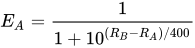
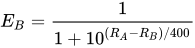
Similarly, the expected score for Player $B$ is:
Linear Rating Adjustments
When a player's actual tournament score exceeds their expected score, the rating increases. The core updating formula is:

Where:
- $R_A$ is the old rating.
- $R'_A$ is the new rating.
- $K$ is the development coefficient (K-factor).
- $S_A$ is the actual score (1 for a win, 0.5 for a draw, 0 for a loss).
- $E_A$ is the expected score.
The K-factor
The K-factor determines how aggressively a rating changes based on recent results. A high K-factor causes rapid changes, while a low K-factor ensures stability.
FIDE K-factor Categories
FIDE splits the K-factor into distinct tiers to balance volatility and experience:
- K = 40: For players new to the rating list until they have completed events with at least 30 games, or for all players until their 18th birthday as long as their rating remains under 2300.
- K = 20: For players with a rating always under 2400.
- K = 10: For players with a rating of at least 2400, once they have reached it. It remains 10 even if their rating drops below 2400.
- K = 20: For all rapid and blitz ratings.
FIDE Rating Tiers and Titles
FIDE awards lifetime titles based on performance and achieving specific Elo thresholds:
| Title | Minimum Elo Requirement | Notes |
|---|---|---|
| Grandmaster (GM) | 2500 | Requires three tournament norms |
| International Master (IM) | 2400 | Requires three tournament norms |
| FIDE Master (FM) | 2300 | Direct title upon hitting rating |
| Candidate Master (CM) | 2200 | Direct title upon hitting rating |
| Woman Grandmaster (WGM) | 2300 | Women-only category |
| Woman International Master (WIM) | 2200 | Women-only category |
Statistical Issues and Criticisms
Despite its widespread adoption, the Elo rating system faces several mathematical and practical limitations.
Rating Inflation and Deflation
Inflation occurs when the average rating of the active player pool increases over time. Deflation occurs when the average rating drops.
- Deflation causes: Master-level players retiring and taking points out of the system, or modern engines creating highly accurate defensive play.
- Inflation causes: Flooding the system with unearned starting points for new players.
The Floor Effect
FIDE historically used a rating floor (e.g., 1000 or 1400). Players dropping to this floor can artificially distort the calculations of opponents who defeat them, as their true strength might be lower than the floor indicates.
Dynamic Drift
Because Elo is a relative system, a rating of 2200 in 1980 does not mathematically guarantee the exact same skill level as a 2200 rating in 2026. This makes cross-generational comparisons difficult.
Alternative Systems
Several modern rating models attempt to fix the flaws of the standard Elo system:
- Glicko rating system: Invented by Mark Glickman, it introduces "Rating Deviation" (RD) to measure the uncertainty of a player's rating based on inactivity.
- Universal Rating System (URS): Developed to combine classical, rapid, and blitz performances into a single, unified rating profile.
- Chess.com / Lichess Glicko-2: Major online platforms use variants of Glicko to handle the extreme volume and volatility of online pool data.
See also
- Chess engine rating lists
- Comparison of top chess players throughout history
- Glicko rating system
- Performance rating (chess)
References
Further reading
- Elo, Arpad (1978). The Rating of Chessplayers, Past and Present. Arco. ISBN 0-668-04721-6.
- Glickman, Mark (1995). "A Comprehensive Guide to Chess Ratings". American Chess Journal.
Category:Chess ratings Category:Evaluation Category:Zero-sum games
Content Disclaimer
Informasi ini disarikan dari Wikipedia dan disajikan kembali untuk tujuan edukasi. Konten tersedia di bawah lisensi CC BY-SA 3.0. Kami tidak bertanggung jawab atas ketidakakuratan data yang bersumber dari kontribusi publik tersebut.
- The information displayed on this website is sourced in part or in whole from Wikipedia and has been adapted for the purpose of restating it. We strive to provide accurate and relevant information, however:
- There is no guarantee of absolute accuracy. Wikipedia is an open, collaborative project that can be edited by anyone, so information is subject to change.
- It is not intended to constitute professional advice. The content displayed is for informational and educational purposes only. For important decisions (e.g., medical, legal, or financial), please consult a professional.
- Content copyright. Wikipedia is licensed under the Creative Commons Attribution-ShareAlike License (CC BY-SA). This means that content may be reused with appropriate attribution and shared under a similar license.
- Responsible use. Any risk arising from the use of information from this website is entirely the responsibility of the user.
LLM-generated pages with certain obvious signs of being machine generated may be deleted without notice.
Instead, only summarize in your own words a range of independent, reliable, published sources that discuss the subject.
See the advice page on large language models for more information.