Expenditure function
In microeconomics, the expenditure function represents the minimum amount of expenditure needed to achieve a given level of utility, given a utility function and the prices of goods.
Formally, if there is a utility function that describes preferences over n goods, the expenditure function is defined as:


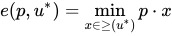
where is the price vector is the desired utility level, is the set of providing at least utility .



Expressed equivalently, the individual minimizes expenditure subject to the minimal utility constraint that giving optimal quantities to consume of the various goods as as function of and the prices; then the expenditure function is




Properties
Suppose is a continuous utility function representing a locally non-satiated preference relation on . Then is

- Homogeneous of degree one in p: for all and ,
- Continuous in and
- Nondecreasing in and strictly increasing in provided
- Concave in
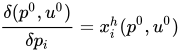
- If the utility function is strictly quasi-concave, there is Shephard's lemma




Proofs
(1) As in the above proposition, note that
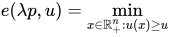
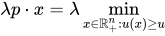

(2) Continue on the domain :

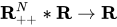
(3) Let and suppose . Then , and . It follows immediately that .




For the second statement, suppose to the contrary that for some , Than, for some , , which contradicts the "no excess utility" conclusion of the previous proposition



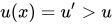
(4) Let and suppose . Then, and , so .


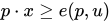



(5)
Expenditure and indirect utility
The expenditure function is the inverse of the indirect utility function when the prices are kept constant. I.e, for every price vector and income level :[1]: 106


There is a duality relationship between the expenditure function and the utility function. If given a specific regular quasi-concave utility function, the corresponding price is homogeneous, and the utility is monotonically increasing expenditure function, conversely, the given price is homogeneous, and the utility is monotonically increasing expenditure function will generate the regular quasi-concave utility function. In addition to the property that prices are once homogeneous and utility is monotonically increasing, the expenditure function usually assumes
- Is a non-negative function, i.e.,
- For P, it is non-decreasing, i.e., ;
- E(Pu) is a concave function. That is,
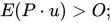



Expenditure function is an important theoretical method to study consumer behavior. Expenditure function is very similar to cost function in production theory. Dual to the utility maximization problem is the cost minimization problem [2][3]
Example
Suppose the utility function is the Cobb-Douglas function which generates the demand functions[4]


where is the consumer's income. One way to find the expenditure function is to first find the indirect utility function and then invert it. The indirect utility function is found by replacing the quantities in the utility function with the demand functions thus:


where Then since when the consumer optimizes, we can invert the indirect utility function to find the expenditure function:



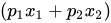
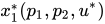
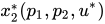
Alternatively, the expenditure function can be found by solving the problem of minimizing subject to the constraint This yields conditional demand functions and and the expenditure function is then


See also
- Expenditure minimization problem
- Hicksian demand function
- Slutsky equation
- Utility maximization problem
- Budget constraint
- Consumption set
- Shephard's lemma
References
- ^ Varian, Hal (1992). Microeconomic Analysis (Third ed.). New York: Norton. ISBN 0-393-95735-7.
- ^ Jing ji xue da ci dian. Xiaomin Liang, 梁小民. (Di 1 ban ed.). Beijing Shi: Tuan jie chu ban she. 1994. ISBN 7-80061-954-0. OCLC 34287945.
{{cite book}}: CS1 maint: others (link) - ^ "CONSUMER CHOICE AND DUALITY" (PDF). 23 February 2024.
- ^ Varian, H. (1992). Microeconomic Analysis (3rd ed.). New York: W. W. Norton. ISBN 978-0-393-95735-8., pp. 111, has the general formula.
Further reading
- Mas-Colell, Andreu; Whinston, Michael D.; Green, Jerry R. (2007). Microeconomic Theory. Oxford University Press. pp. 59–60. ISBN 978-0-19-510268-0.
- Mathis, Stephen A.; Koscianski, Janet (2002). Microeconomic Theory: An Integrated Approach. Upper Saddle River: Prentice Hall. pp. 132–133. ISBN 0-13-011418-9.
- Varian, Hal R. (1984). Microeconomic Analysis (Second ed.). New York: W. W. Norton. pp. 121–123. ISBN 0-393-95282-7.
Content Disclaimer
Informasi ini disarikan dari Wikipedia dan disajikan kembali untuk tujuan edukasi. Konten tersedia di bawah lisensi CC BY-SA 3.0. Kami tidak bertanggung jawab atas ketidakakuratan data yang bersumber dari kontribusi publik tersebut.
- The information displayed on this website is sourced in part or in whole from Wikipedia and has been adapted for the purpose of restating it. We strive to provide accurate and relevant information, however:
- There is no guarantee of absolute accuracy. Wikipedia is an open, collaborative project that can be edited by anyone, so information is subject to change.
- It is not intended to constitute professional advice. The content displayed is for informational and educational purposes only. For important decisions (e.g., medical, legal, or financial), please consult a professional.
- Content copyright. Wikipedia is licensed under the Creative Commons Attribution-ShareAlike License (CC BY-SA). This means that content may be reused with appropriate attribution and shared under a similar license.
- Responsible use. Any risk arising from the use of information from this website is entirely the responsibility of the user.