Explicit and implicit methods
 | This article needs more citations. (December 2009) |
Explicit and implicit methods are approaches used in numerical analysis for obtaining numerical approximations to the solutions of ordinary and partial differential equations, as is required in computer simulations of physical processes. Explicit methods calculate the state of a system at a later time from the state of the system at the current time, while implicit methods find a solution by solving an equation involving both the current state of the system and the later one. Mathematically, if is the current system state and is the state at the later time ( is a small time step), then, for an explicit method



while for an implicit method one solves an equation

to find

Computation
Implicit methods require an extra computation (solving the above equation), and they can be much harder to implement. Implicit methods are used because many problems arising in practice are stiff, for which the use of an explicit method requires impractically small time steps to keep the error in the result bounded (see numerical stability). For such problems, to achieve given accuracy, it takes much less computational time to use an implicit method with larger time steps, even taking into account that one needs to solve an equation of the form (1) at each time step. That said, whether one should use an explicit or implicit method depends upon the problem to be solved.
Since the implicit method cannot be carried out for each kind of differential operator, it is sometimes advisable to make use of the so called operator splitting method, which means that the differential operator is rewritten as the sum of two complementary operators

while one is treated explicitly and the other implicitly. For usual applications the implicit term is chosen to be linear while the explicit term can be nonlinear. This combination of the former method is called Implicit-Explicit Method (short IMEX,[1][2][3]).
Illustration using the forward and backward Euler methods
Consider the ordinary differential equation
![{\displaystyle {\frac {dy}{dt}}=-y^{2},\ t\in [0,a]\quad \quad (2)}](https://wikimedia.org/api/rest_v1/media/math/render/svg/2da9a469600ad22b47c72ac29e5705592594d712)
with the initial condition This problem has the exact solution , which usually cannot be written down for problems encountered in practice, but in this case allows a comparison with the numerical solutions. Consider a grid for 0 ≤ k ≤ n, that is, the time step is and denote for each . Discretize this equation using the simplest explicit and implicit methods, which are the forward Euler and backward Euler methods (see numerical ordinary differential equations) and compare the obtained schemes.


- Forward Euler method

![{\displaystyle y'=-y^{2},\;t\in [0,5],\;y_{0}=1}](https://wikimedia.org/api/rest_v1/media/math/render/svg/3417b09298cdd5cb37559b2b094310257a20d2bf)

The forward Euler method
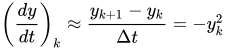
yields

for each This is an explicit formula for .


- Backward Euler method
With the backward Euler method
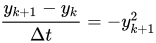
one finds the implicit equation

for (compare this with formula (3) where was given explicitly rather than as an unknown in an equation).
This is a quadratic equation, having one negative and one positive root. The positive root is picked because in the original equation the initial condition is positive, and then at the next time step is given by


In the vast majority of cases, the equation to be solved when using an implicit scheme is much more complicated than a quadratic equation, and no analytical solution exists. Then one uses root-finding algorithms, such as Newton's method, to find the numerical solution.
- Crank-Nicolson method
The Crank-Nicolson method, also known as the trapezoidal rule, can be thought of as an average of the forward and backward Euler methods. For the differential equation considered above, this gives

leading to the implicit equation

for (compare this with formula (3) where was given explicitly rather than as an unknown in an equation). This can be numerically solved using root-finding algorithms, such as Newton's method, to obtain .
The advantage of this method is its improved accuracy (see diagram above). Both Euler methods are first order, but the trapezoidal method is second order.
- IMEX methods
Because of the difficulty of solving implicit equations, some methods use an implicit method for linear terms and an explicit method for nonlinear terms. These are called IMEX (Implicit-Explicit) schemes.


To illustrate the idea of IMEX schemes, consider a slightly different differential equation:
![{\displaystyle {\frac {dy}{dt}}=y-y^{2},\ t\in [0,a]\quad \quad (5)}](https://wikimedia.org/api/rest_v1/media/math/render/svg/f18ea769b80c985190a3cdd00aab67ab5e172ee8)
Using implicit Euler for the linear term and explicit Euler for the nonlinear term gives
![{\displaystyle {\frac {y_{k+1}-y_{k}}{\Delta t}}\approx y_{k+1}-y_{k}^{2},\ t\in [0,a].}](https://wikimedia.org/api/rest_v1/media/math/render/svg/0e60cd394b6a7f881d3c1a813e9510d0409fb786)
This equation is linear in so it can be solved to give

for each This method is sometimes called the Forward-Backward Euler method (see diagram).
See also
- Courant–Friedrichs–Lewy condition
- SIMPLE algorithm, a semi-implicit method for pressure-linked equations
Sources
- ^ U.M. Ascher, S.J. Ruuth, R.J. Spiteri: Implicit-Explicit Runge-Kutta Methods for Time-Dependent Partial Differential Equations, Appl Numer Math, vol. 25(2-3), 1997
- ^ L.Pareschi, G.Russo: Implicit-Explicit Runge-Kutta schemes for stiff systems of differential equations, Recent Trends in Numerical Analysis, Vol. 3, 269-289, 2000
- ^ Sebastiano Boscarino, Lorenzo Pareschi, and Giovanni Russo: Implicit-Explicit Methods for Evolutionary Partial Differential Equations, SIAM, ISBN 978-1-61197-819-3 (2024).
Content Disclaimer
Informasi ini disarikan dari Wikipedia dan disajikan kembali untuk tujuan edukasi. Konten tersedia di bawah lisensi CC BY-SA 3.0. Kami tidak bertanggung jawab atas ketidakakuratan data yang bersumber dari kontribusi publik tersebut.
- The information displayed on this website is sourced in part or in whole from Wikipedia and has been adapted for the purpose of restating it. We strive to provide accurate and relevant information, however:
- There is no guarantee of absolute accuracy. Wikipedia is an open, collaborative project that can be edited by anyone, so information is subject to change.
- It is not intended to constitute professional advice. The content displayed is for informational and educational purposes only. For important decisions (e.g., medical, legal, or financial), please consult a professional.
- Content copyright. Wikipedia is licensed under the Creative Commons Attribution-ShareAlike License (CC BY-SA). This means that content may be reused with appropriate attribution and shared under a similar license.
- Responsible use. Any risk arising from the use of information from this website is entirely the responsibility of the user.