FastICA
 | This article relies on a single source. (April 2013) |
FastICA is an efficient and popular algorithm for independent component analysis invented by Aapo Hyvärinen at Helsinki University of Technology.[1][2] Like most ICA algorithms, FastICA seeks an orthogonal rotation of prewhitened data, through a fixed-point iteration scheme, that maximizes a measure of non-Gaussianity of the rotated components. Non-gaussianity serves as a proxy for statistical independence, which is a very strong condition and requires infinite data to verify. FastICA can also be alternatively derived as an approximative Newton iteration.
Algorithm
Prewhitening the data
Let the denote the input data matrix, the number of columns corresponding with the number of samples of mixed signals and the number of rows corresponding with the number of independent source signals. The input data matrix must be prewhitened, or centered and whitened, before applying the FastICA algorithm to it.



- Centering the data entails demeaning each component of the input data , that is,
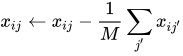
- for each and . After centering, each row of has an expected value of .



- Whitening the data requires a linear transformation of the centered data so that the components of are uncorrelated and have variance one. More precisely, if is a centered data matrix, the covariance of is the -dimensional identity matrix, that is,



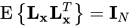
- A common method for whitening is by performing an eigenvalue decomposition on the covariance matrix of the centered data , , where is the matrix of eigenvectors and is the diagonal matrix of eigenvalues. The whitened data matrix is defined thus by




Single component extraction
The iterative algorithm finds the direction for the weight vector that maximizes a measure of non-Gaussianity of the projection , with denoting a prewhitened data matrix as described above. Note that is a column vector. To measure non-Gaussianity, FastICA relies on a nonquadratic nonlinear function , its first derivative , and its second derivative . Hyvärinen states that the functions



are useful for general purposes, while

may be highly robust.[1] The steps for extracting the weight vector for single component in FastICA are the following:
- Randomize the initial weight vector
- Let , where means averaging over all column-vectors of matrix
- Let
- If not converged, go back to 2



Multiple component extraction
The single unit iterative algorithm estimates only one weight vector which extracts a single component. Estimating additional components that are mutually "independent" requires repeating the algorithm to obtain linearly independent projection vectors - note that the notion of independence here refers to maximizing non-Gaussianity in the estimated components. Hyvärinen provides several ways of extracting multiple components with the simplest being the following. Here, is a column vector of 1's of dimension .

Algorithm FastICA
- Input: Number of desired components
- Input: Prewhitened matrix, where each column represents an -dimensional sample, where
- Output: Un-mixing matrix where each column projects onto independent component.
- Output: Independent components matrix, with columns representing a sample with dimensions.


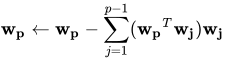
for p in 1 to C:
Random vector of length N
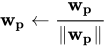
while changes
output
output





See also
- Unsupervised learning
- Machine learning
- The IT++ library features a FastICA implementation in C++
- Infomax
References
- ^ a b Hyvärinen, A.; Oja, E. (2000). "Independent component analysis: Algorithms and applications" (PDF). Neural Networks. 13 (4–5): 411–430. CiteSeerX 10.1.1.79.7003. doi:10.1016/S0893-6080(00)00026-5. PMID 10946390.
{{cite journal}}: Cite uses deprecated parameter|citeseerx=(help) - ^ Hyvarinen, A. (1999). "Fast and robust fixed-point algorithms for independent component analysis" (PDF). IEEE Transactions on Neural Networks. 10 (3): 626–634. CiteSeerX 10.1.1.297.8229. doi:10.1109/72.761722. PMID 18252563.
{{cite journal}}: Cite uses deprecated parameter|citeseerx=(help)
External links
Content Disclaimer
Informasi ini disarikan dari Wikipedia dan disajikan kembali untuk tujuan edukasi. Konten tersedia di bawah lisensi CC BY-SA 3.0. Kami tidak bertanggung jawab atas ketidakakuratan data yang bersumber dari kontribusi publik tersebut.
- The information displayed on this website is sourced in part or in whole from Wikipedia and has been adapted for the purpose of restating it. We strive to provide accurate and relevant information, however:
- There is no guarantee of absolute accuracy. Wikipedia is an open, collaborative project that can be edited by anyone, so information is subject to change.
- It is not intended to constitute professional advice. The content displayed is for informational and educational purposes only. For important decisions (e.g., medical, legal, or financial), please consult a professional.
- Content copyright. Wikipedia is licensed under the Creative Commons Attribution-ShareAlike License (CC BY-SA). This means that content may be reused with appropriate attribution and shared under a similar license.
- Responsible use. Any risk arising from the use of information from this website is entirely the responsibility of the user.