Ferroics
 | This article has multiple issues. Please help improve it or discuss these issues on the talk page. (Learn how and when to remove these messages)
|


In physics, ferroics is the study of ferromagnets, ferroelectrics, and ferroelastics.
Phase transitions
The basis of ferroics is to understand large changes in physical characteristics that can occur over a narrow temperature range. Changes in physical characteristics occur when phase transitions take place around some critical temperature value, normally denoted by . Above this critical temperature, the crystal is in a nonferroic state and does not exhibit ferroic characteristics. Falling below it undergoes a spontaneous phase transition. Such a transition typically results in a small deviation from the nonferroic crystal structure, but with a different shape of the unit cell, the point symmetry of the material is reduced. This breaking of symmetry allows the formation of the ferroic phase.

Lowering the temperature below includes a spontaneous dipole moment along an axis of the unit cell. Although individual dipole moments can sometimes be small, the effect of unit cells gives rise to a significant electric field.

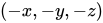
Ferroelectrics cannot exist in a centrosymmetric crystal. A centrosymmetric crystal is one where lattice point can be mapped onto lattice point .

The spontaneous magnetization of a ferromagnet can be attributed to a breaking of point symmetry in switching from the paramagnetic to the ferromagnetic phase. In this case, is known as the Curie temperature.
In ferroelastic crystals, in going from the nonferroic (or prototypic phase) to the ferroic phase, a spontaneous strain is induced. An example of a ferroelastic phase transition is when the crystal structure spontaneously changes from a tetragonal structure (a square prism shape) to a monoclinic structure (a general parallelepiped). Here the shapes of the unit cell before and after the phase transition are different, inducing a strain within the material.
Variants
Multiferroic materials exhibit more than one ferroic property simultaneously in a single phase.
A fourth ferroic order termed ferrotoroidic order has been proposed.[1]
Many ferroic phase transitions have been studied under non-equilibrium conditions.[2] Under energy disspative condition, quantum system or event colloid particles may shows ferrioic-like order which can be regarded as a nonequilibrium analogue to ferroic material. For example, chemically reactive colloidal particles have been observed to exhibit criticality and long-range order, collectively referred to as ferrochemical order.[3]
See also
References
- ^ Gnewuch, Stephanie; Rodriguez, Efrain E. (2019-03-01). "The fourth ferroic order: Current status on ferrotoroidic materials". Journal of Solid State Chemistry. 271: 175–190. Bibcode:2019JSSCh.271..175G. doi:10.1016/j.jssc.2018.12.035. ISSN 0022-4596.
- ^ Henkel, Malte; Hinrichsen, Haye; Lübeck, Sven (2008). Non-Equilibrium Phase Transitions: Volume I: Absorbing Phase Transitions. Dordrecht: Springer Netherlands.
- ^ "Ferrochemical Order in Chemically Reactive Colloids". Journal of the American Chemical Society. 147 (44): 40225–40235. 2025.
Content Disclaimer
Informasi ini disarikan dari Wikipedia dan disajikan kembali untuk tujuan edukasi. Konten tersedia di bawah lisensi CC BY-SA 3.0. Kami tidak bertanggung jawab atas ketidakakuratan data yang bersumber dari kontribusi publik tersebut.
- The information displayed on this website is sourced in part or in whole from Wikipedia and has been adapted for the purpose of restating it. We strive to provide accurate and relevant information, however:
- There is no guarantee of absolute accuracy. Wikipedia is an open, collaborative project that can be edited by anyone, so information is subject to change.
- It is not intended to constitute professional advice. The content displayed is for informational and educational purposes only. For important decisions (e.g., medical, legal, or financial), please consult a professional.
- Content copyright. Wikipedia is licensed under the Creative Commons Attribution-ShareAlike License (CC BY-SA). This means that content may be reused with appropriate attribution and shared under a similar license.
- Responsible use. Any risk arising from the use of information from this website is entirely the responsibility of the user.