Filter factor
 | This article relies on a single source. (October 2025) |
In photography, filter factor[1] refers to the multiplicative amount of light a filter blocks.
Converting between filter factors and stops
The table below illustrates the relationship between filter factor, the amount of light that is allowed through the filter, and the number of stops this corresponds to.
| Filter factor | Proportion of light transmitted (1/FF) | Number of stops |
|---|---|---|
| 1 | 95–100% | 0 |
| 1.3 | 75% (3/4) | 1⁄3 |
| 1.4 | 70% | 1⁄2 |
| 1.5 | 67% (2/3) | 2⁄3 |
| 2 | 50% (1/2) | 1 |
| 2.5 | 40% (2/5) | 11⁄3 |
| 3 | 33% (1/3) | 12⁄3 |
| 4 | 25% (1/4) | 2 |
| 8 | 12.5% (1/8) | 3 |
| 16 | 6.25% (1/16) | 4 |
Calculating exposure increase
The number of f-stops of light reduction, given a filter factor, may be calculated using the formula:

Most calculators do not have a function. An equivalent calculation is:


or

An example: A green filter with a filter factor of 4


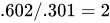
The green filter factor of 4 yields a 2 f-stop light reduction.
The filter factor, given the exposure change in f-stops, may be calculated using the formula:

An example: A deep red filter with an f-stop change of 3 stops

A change of 3 f-stops is equivalent to a filter factor of 8.
As a consequence of this relationship, filter factors should be multiplied together when such filters are stacked, as opposed to stop adjustments, which should be added together.
Filter factors for common filters
The table below gives approximate filter factors for a variety of common photographic filters. Filter factors are highly dependent on the spectral response curve of the film being used. Thus, filter factors provided by the film manufacturer should be preferred over the ones documented below. Furthermore, these factors are for daylight color temperature (5600K); when shooting under a different color temperature of ambient light, these values will most likely be incorrect.
| Filter purpose | Wratten number | Other designation | Filter factor |
|---|---|---|---|
| Ultraviolet | UV(0) | 1 | |
| Skylight | 1A or 1B | KR1.5 | 1 |
| Contrast filters | |||
| Yellow | 8 | Y, K2, Y48, 022 | 2 |
| Yellow-green | 11 | X0 | 2.5 |
| Orange | 21 | 3 | |
| Red | 25 | A, 090, R2 | 8 |
| Deep Red | 29 | F, 091 | 20 |
| Green | 58 | X1 | 4 |
| Infra-Red | 89B | R72 | 16 |
| Infra-Red | 70 | 092 | 20-40 |
| Colour conversion (blue) | |||
| 3200 K to 5500 K | 80A | KB15 | 4 |
| 3400 K to 5500 K | 80B | KB12 | 3 |
| 3800 K to 5500 K | 80C | KB6 | 2 |
| Warming filters | |||
| 3400 K to 3200 K | 81A | A2 | 1.4 |
| 3500 K to 3200 K | 81B | 1.4 | |
| 3600 K to 3200 K | 81C | KR3 | 1.4 |
| 3700 K to 3200 K | 81D | 1.5 | |
| 3850 K to 3200 K | 81EF | KR6 | 1.5 |
| Cooling filters | |||
| 3000 K to 3200 K | 82A | B2, KB1.5 | 1.3 |
| 2900 K to 3200 K | 82B | 1.5 | |
| 2800 K to 3200 K | 82C | KB3 | 1.5 |
| Colour conversion (orange) | |||
| 5500 K to 3400 K | 85 / 85A | KR12 | 1.6 |
| 5500 K to 3200 K | 85B | KR15 | 1.6 |
| 5500 K to 3800 K | 85C | 1.3 | |
| Neutral density | |||
| 0.3 | 96 | NDx2 | 2 |
| 0.6 | 96 | NDx4 | 4 |
| 0.9 | 96 | NDx8 | 8 |
| 3.0 | 96 | NDx1000 | 1000 |
| Polarizers | |||
| Linear polarizer | PL or LP | 3 to 4 | |
| Circular polarizer | PL-Cir, C-PL, CP | 3 to 4 | |
See also
References
- Notes
- ^ Almeda, Darlene. "Shedding Light on Filter Factors: A Guide to Optimizing Exposure in Photography". photoscapes.com. Retrieved 3 October 2025.
- Further reading
- Hoya Corporation, Filters for imaging
- Cokin S.A., Cokin Creative Filter System
Content Disclaimer
Informasi ini disarikan dari Wikipedia dan disajikan kembali untuk tujuan edukasi. Konten tersedia di bawah lisensi CC BY-SA 3.0. Kami tidak bertanggung jawab atas ketidakakuratan data yang bersumber dari kontribusi publik tersebut.
- The information displayed on this website is sourced in part or in whole from Wikipedia and has been adapted for the purpose of restating it. We strive to provide accurate and relevant information, however:
- There is no guarantee of absolute accuracy. Wikipedia is an open, collaborative project that can be edited by anyone, so information is subject to change.
- It is not intended to constitute professional advice. The content displayed is for informational and educational purposes only. For important decisions (e.g., medical, legal, or financial), please consult a professional.
- Content copyright. Wikipedia is licensed under the Creative Commons Attribution-ShareAlike License (CC BY-SA). This means that content may be reused with appropriate attribution and shared under a similar license.
- Responsible use. Any risk arising from the use of information from this website is entirely the responsibility of the user.