Flat pseudospectral method
The flat pseudospectral method is part of the family of the Ross–Fahroo pseudospectral methods introduced by Ross and Fahroo.[1][2] The method combines the concept of differential flatness with pseudospectral optimal control to generate outputs in the so-called flat space.[3][4]
Concept
Because the differentiation matrix, , in a pseudospectral method is square, higher-order derivatives of any polynomial, , can be obtained by powers of ,


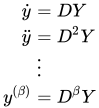
where is the pseudospectral variable and is a finite positive integer. By differential flatness, there exists functions and such that the state and control variables can be written as,


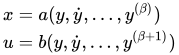
The combination of these concepts generates the flat pseudospectral method; that is, x and u are written as,


Thus, an optimal control problem can be quickly and easily transformed to a problem with just the Y pseudospectral variable.[1]
See also
References
- ^ a b Ross, I. M. and Fahroo, F., “Pseudospectral Methods for the Optimal Motion Planning of Differentially Flat Systems,” IEEE Transactions on Automatic Control, Vol.49, No.8, pp. 1410–1413, August 2004.
- ^ Ross, I. M. and Fahroo, F., “A Unified Framework for Real-Time Optimal Control,” Proceedings of the IEEE Conference on Decision and Control, Maui, HI, December, 2003.
- ^ Fliess, M., Lévine, J., Martin, Ph., and Rouchon, P., “Flatness and defect of nonlinear systems: Introductory theory and examples,” International Journal of Control, vol. 61, no. 6, pp. 1327–1361, 1995.
- ^ Rathinam, M. and Murray, R. M., “Configuration flatness of Lagrangian systems underactuated by one control” SIAM Journal on Control and Optimization, 36, 164,1998.
Content Disclaimer
Informasi ini disarikan dari Wikipedia dan disajikan kembali untuk tujuan edukasi. Konten tersedia di bawah lisensi CC BY-SA 3.0. Kami tidak bertanggung jawab atas ketidakakuratan data yang bersumber dari kontribusi publik tersebut.
- The information displayed on this website is sourced in part or in whole from Wikipedia and has been adapted for the purpose of restating it. We strive to provide accurate and relevant information, however:
- There is no guarantee of absolute accuracy. Wikipedia is an open, collaborative project that can be edited by anyone, so information is subject to change.
- It is not intended to constitute professional advice. The content displayed is for informational and educational purposes only. For important decisions (e.g., medical, legal, or financial), please consult a professional.
- Content copyright. Wikipedia is licensed under the Creative Commons Attribution-ShareAlike License (CC BY-SA). This means that content may be reused with appropriate attribution and shared under a similar license.
- Responsible use. Any risk arising from the use of information from this website is entirely the responsibility of the user.