Freivalds' algorithm
Freivalds' algorithm (named after Rūsiņš Mārtiņš Freivalds) is a probabilistic randomized algorithm used to verify matrix multiplication. Given three n × n matrices , , and , a general problem is to verify whether . A naïve algorithm would compute the product explicitly and compare term by term whether this product equals . However, the best known matrix multiplication algorithm runs in time. Freivalds' algorithm utilizes randomization in order to reduce this time bound to [1] with high probability. In time the algorithm can verify a matrix product with probability of failure less than .


The algorithm
Input
Three n × n matrices , , and .
Output
Yes, if ; No, otherwise.
Procedure



Error
If , then the algorithm always returns "Yes". If , then the probability that the algorithm returns "Yes" is less than or equal to one half. This is called one-sided error.

By iterating the algorithm k times and returning "Yes" only if all iterations yield "Yes", a runtime of and error probability of is achieved.

Example
Suppose one wished to determine whether:

A random two-element vector with entries equal to 0 or 1 is selected – say – and used to compute:

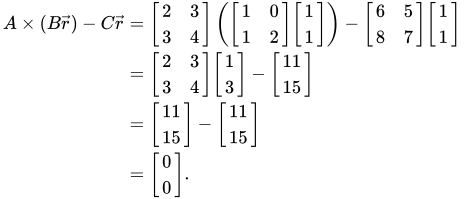
This yields the zero vector, suggesting the possibility that AB = C. However, if in a second trial the vector is selected, the result becomes:


The result is nonzero, proving that in fact AB ≠ C.
There are four two-element 0/1 vectors, and half of them give the zero vector in this case ( and ), so the chance of randomly selecting these in two trials (and falsely concluding that AB=C) is 1/22 or 1/4. In the general case, the proportion of r yielding the zero vector may be less than 1/2, and a larger number of trials (such as 20) would be used, rendering the probability of error very small.

Error analysis
Let p equal the probability of error. We claim that if A × B = C, then p = 0, and if A × B ≠ C, then p ≤ 1/2.
Case A × B = C
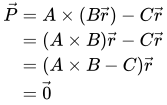
This is regardless of the value of , since it uses only that . Hence the probability for error in this case is:

![{\displaystyle \Pr[{\vec {P}}\neq 0]=0}](https://wikimedia.org/api/rest_v1/media/math/render/svg/c73087a7efc162b4e75c6865e98c1d05aec25a0a)
Case A × B ≠ C
Let such that


Where
- .

Since , we have that some element of is nonzero. Suppose that the element . By the definition of matrix multiplication, we have:

- .

For some constant . Using Bayes' theorem, we can partition over :

| 1 |
![{\displaystyle \Pr[p_{i}=0]=\Pr[p_{i}=0|y=0]\cdot \Pr[y=0]\,+\,\Pr[p_{i}=0|y\neq 0]\cdot \Pr[y\neq 0]}](https://wikimedia.org/api/rest_v1/media/math/render/svg/ee0c1200643490dc0be3f3c50339db18734b4e7c)
We use that:
![{\displaystyle \Pr[p_{i}=0|y=0]=\Pr[r_{j}=0]={\frac {1}{2}}}](https://wikimedia.org/api/rest_v1/media/math/render/svg/7c5a17eb0d50e08bb9a83418bf18f5ada6d2b210)
![{\displaystyle \Pr[p_{i}=0|y\neq 0]=\Pr[r_{j}=1\land d_{ij}=-y]\leq \Pr[r_{j}=1]={\frac {1}{2}}}](https://wikimedia.org/api/rest_v1/media/math/render/svg/c0ba405df9fd611dbb73bf7c9bf4eac801ae8a30)
Plugging these in the equation (1), we get:
![{\displaystyle {\begin{aligned}\Pr[p_{i}=0]&\leq {\frac {1}{2}}\cdot \Pr[y=0]+{\frac {1}{2}}\cdot \Pr[y\neq 0]\\&={\frac {1}{2}}\cdot \Pr[y=0]+{\frac {1}{2}}\cdot (1-\Pr[y=0])\\&={\frac {1}{2}}\end{aligned}}}](https://wikimedia.org/api/rest_v1/media/math/render/svg/ac04124bbed15468913248264a3f495d919efe2e)
Therefore,
![{\displaystyle \Pr[{\vec {P}}=0]=\Pr[p_{1}=0\land \dots \land p_{i}=0\land \dots \land p_{n}=0]\leq \Pr[p_{i}=0]\leq {\frac {1}{2}}.}](https://wikimedia.org/api/rest_v1/media/math/render/svg/0e355ff8aa8a654e52019735c8e960fc2555f859)
This completes the proof.
Ramifications
Simple algorithmic analysis shows that the running time of this algorithm is (in big O notation). This beats the classical deterministic algorithm's runtime of (or if using fast matrix multiplication). The error analysis also shows that if the algorithm is run times, an error bound of less than can be achieved, an exponentially small quantity. The algorithm is also fast in practice due to wide availability of fast implementations for matrix-vector products. Therefore, utilization of randomized algorithms can speed up a very slow deterministic algorithm.


Freivalds' algorithm frequently arises in introductions to probabilistic algorithms because of its simplicity and how it illustrates the superiority of probabilistic algorithms in practice for some problems.
See also
References
- ^ Raghavan, Prabhakar (1997). "Randomized algorithms". ACM Computing Surveys. 28: 33–37. doi:10.1145/234313.234327. S2CID 207196543.
- Freivalds, R. (1977). "Probabilistic Machines Can Use Less Running Time". Information processing 77 : proceedings of IFIP Congress 77, Toronto, August 8-12, 1977. North-Holland. pp. 839–842. ISBN 0-7204-0755-9. OCLC 878720415.
- Mitzenmacher, Michael; Upfal, Eli (2005). "1.3 Application: Verifying Matrix Multiplication". Probability and computing: Randomized algorithms and probabilistic analysis. Cambridge University Press. pp. 8–12. ISBN 0-521-83540-2.
Content Disclaimer
Informasi ini disarikan dari Wikipedia dan disajikan kembali untuk tujuan edukasi. Konten tersedia di bawah lisensi CC BY-SA 3.0. Kami tidak bertanggung jawab atas ketidakakuratan data yang bersumber dari kontribusi publik tersebut.
- The information displayed on this website is sourced in part or in whole from Wikipedia and has been adapted for the purpose of restating it. We strive to provide accurate and relevant information, however:
- There is no guarantee of absolute accuracy. Wikipedia is an open, collaborative project that can be edited by anyone, so information is subject to change.
- It is not intended to constitute professional advice. The content displayed is for informational and educational purposes only. For important decisions (e.g., medical, legal, or financial), please consult a professional.
- Content copyright. Wikipedia is licensed under the Creative Commons Attribution-ShareAlike License (CC BY-SA). This means that content may be reused with appropriate attribution and shared under a similar license.
- Responsible use. Any risk arising from the use of information from this website is entirely the responsibility of the user.