Gap-Hamming problem
In communication complexity, the gap-Hamming problem asks, if Alice and Bob are each given a (potentially different) string, what is the minimal number of bits that they need to exchange in order for Alice to approximately compute the Hamming distance between their strings. The solution to the problem roughly states that, if Alice and Bob are each given a string, then any communication protocol used to compute the Hamming distance between their strings does (asymptotically) no better than Bob sending his whole string to Alice. More specifically, if Alice and Bob are each given -bit strings, there exists no communication protocol that lets Alice compute the hamming distance between their strings to within using less than bits.


The gap-Hamming problem has applications to proving lower bounds for many streaming algorithms, including moment frequency estimation[1] and entropy estimation.[2]
Formal statement
In this problem, Alice and Bob each receive a string, and , respectively, while Alice is required to compute the (partial) function,


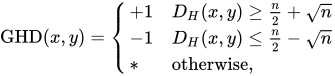
using the least amount of communication possible. Here, indicates that Alice can return either of and is the Hamming distance between and . In other words, Alice needs to return whether Bob's string is significantly similar or significantly different from hers while minimizing the number of bits she exchanges with Bob.


The problem's solution states that computing requires at least communication. In particular, it requires communication even when and are chosen uniformly at random from .


History
The gap-Hamming problem was originally proposed by Indyk and Woodruff in the early 2000s, who initially proved a linear lower bound on the one-way communication complexity of the problem (where Alice is only allowed to receive data from Bob) and conjectured a linear lower bound in the general case.[3] The question of the infinite-round case (in which Alice and Bob are allowed to exchange as many messages as desired) remained open until Chakrabarti and Regev proved, via an anti-concentration argument, that the general problem also has linear lower bound complexity, thus settling the original question completely.[4] This result was followed by a series of other papers that sought to simplify or find new approaches to proving the desired lower bound, notably first by Vidick[5] and later by Sherstov,[6] and, recently, with an information-theoretic approach by Hadar, Liu, Polyanskiy, and Shayevitz.[7]
References
- ^ Indyk, Piotr; Woodruff, David (2005). "Optimal approximations of the frequency moments of data streams". Proceedings of the thirty-seventh annual ACM symposium on Theory of computing - STOC '05. p. 202. doi:10.1145/1060590.1060621. ISBN 9781581139600. S2CID 7911758.
- ^ Chakrabarti, Amit; Cormode, Graham; Mcgregor, Andrew (2010). "A Near-optimal Algorithm for Estimating the Entropy of a Stream". ACM Transactions on Algorithms. 6 (3): 1–21. CiteSeerX 10.1.1.190.5419. doi:10.1145/1798596.1798604. ISSN 1549-6325. S2CID 6733816.
{{cite journal}}: Cite uses deprecated parameter|citeseerx=(help) - ^ Indyk, P.; Woodruff, D. (2003). "Tight lower bounds for the distinct elements problem". 44th Annual IEEE Symposium on Foundations of Computer Science, 2003. Proceedings. pp. 283–288. doi:10.1109/SFCS.2003.1238202. ISBN 9780769520407. S2CID 7648045.
- ^ Chakrabarti, Amit; Regev, Oded (2011). "An optimal lower bound on the communication complexity of gap-hamming-distance". Proceedings of the 43rd annual ACM symposium on Theory of computing - STOC '11. p. 51. arXiv:1009.3460. doi:10.1145/1993636.1993644. ISBN 9781450306911. S2CID 10274326.
- ^ Vidick, Thomas (2012). "A concentration inequality for the overlap of a vector on a large set, with application to the communication complexity of the gap-Hamming-Distance problem". Chicago Journal of Theoretical Computer Science. 18: 1–12. doi:10.4086/cjtcs.2012.001.
- ^ Sherstov, Alexander A. (2012-05-17). "The Communication Complexity of Gap Hamming Distance". Theory of Computing. 8 (1): 197–208. doi:10.4086/toc.2012.v008a008. ISSN 1557-2862.
- ^ Shayevitz, Ofer; Polyanskiy, Yury; Liu, Jingbo; Hadar, Uri (2019-01-25). "Communication Complexity of Estimating Correlations". arXiv:1901.09100v2 [cs.IT].
Content Disclaimer
Informasi ini disarikan dari Wikipedia dan disajikan kembali untuk tujuan edukasi. Konten tersedia di bawah lisensi CC BY-SA 3.0. Kami tidak bertanggung jawab atas ketidakakuratan data yang bersumber dari kontribusi publik tersebut.
- The information displayed on this website is sourced in part or in whole from Wikipedia and has been adapted for the purpose of restating it. We strive to provide accurate and relevant information, however:
- There is no guarantee of absolute accuracy. Wikipedia is an open, collaborative project that can be edited by anyone, so information is subject to change.
- It is not intended to constitute professional advice. The content displayed is for informational and educational purposes only. For important decisions (e.g., medical, legal, or financial), please consult a professional.
- Content copyright. Wikipedia is licensed under the Creative Commons Attribution-ShareAlike License (CC BY-SA). This means that content may be reused with appropriate attribution and shared under a similar license.
- Responsible use. Any risk arising from the use of information from this website is entirely the responsibility of the user.