Generalized linear array model
In statistics, the generalized linear array model (GLAM) is used for analyzing data sets with array structures. It based on the generalized linear model with the design matrix written as a Kronecker product.
Overview
The generalized linear array model or GLAM was introduced in 2006.[1] Such models provide a structure and a computational procedure for fitting generalized linear models or GLMs whose model matrix can be written as a Kronecker product and whose data can be written as an array. In a large GLM, the GLAM approach gives very substantial savings in both storage and computational time over the usual GLM algorithm.
Suppose that the data is arranged in a -dimensional array with size ; thus, the corresponding data vector has size . Suppose also that the design matrix is of the form






The standard analysis of a GLM with data vector and design matrix proceeds by repeated evaluation of the scoring algorithm



where represents the approximate solution of , and is the improved value of it; is the diagonal weight matrix with elements


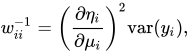
and

is the working variable.
Computationally, GLAM provides array algorithms to calculate the linear predictor,

and the weighted inner product

without evaluation of the model matrix

Example
In 2 dimensions, let , then the linear predictor is written where is the matrix of coefficients; the weighted inner product is obtained from and is the matrix of weights; here is the row tensor function of the matrix given by[1]







where means element by element multiplication and is a vector of 1's of length .


On the other hand, the row tensor function of the matrix is the example of Face-splitting product of matrices, which was proposed by Vadym Slyusar in 1996:[2][3][4][5]

where means Face-splitting product.

These low storage high speed formulae extend to -dimensions.
Applications
GLAM is designed to be used in -dimensional smoothing problems where the data are arranged in an array and the smoothing matrix is constructed as a Kronecker product of one-dimensional smoothing matrices.
References
- ^ a b Currie, I. D.; Durban, M.; Eilers, P. H. C. (2006). "Generalized linear array models with applications to multidimensional smoothing". Journal of the Royal Statistical Society. 68 (2): 259–280. doi:10.1111/j.1467-9868.2006.00543.x. S2CID 10261944.
- ^ Slyusar, V. I. (December 27, 1996). "End products in matrices in radar applications" (PDF). Radioelectronics and Communications Systems. 41 (3): 50–53.
- ^ Slyusar, V. I. (1997-05-20). "Analytical model of the digital antenna array on a basis of face-splitting matrix products" (PDF). Proc. ICATT-97, Kyiv: 108–109.
- ^ Slyusar, V. I. (1997-09-15). "New operations of matrices product for applications of radars" (PDF). Proc. Direct and Inverse Problems of Electromagnetic and Acoustic Wave Theory (DIPED-97), Lviv.: 73–74.
- ^ Slyusar, V. I. (March 13, 1998). "A Family of Face Products of Matrices and its Properties" (PDF). Cybernetics and Systems Analysis C/C of Kibernetika I Sistemnyi Analiz. 1999. 35 (3): 379–384. doi:10.1007/BF02733426. S2CID 119661450.
Content Disclaimer
Informasi ini disarikan dari Wikipedia dan disajikan kembali untuk tujuan edukasi. Konten tersedia di bawah lisensi CC BY-SA 3.0. Kami tidak bertanggung jawab atas ketidakakuratan data yang bersumber dari kontribusi publik tersebut.
- The information displayed on this website is sourced in part or in whole from Wikipedia and has been adapted for the purpose of restating it. We strive to provide accurate and relevant information, however:
- There is no guarantee of absolute accuracy. Wikipedia is an open, collaborative project that can be edited by anyone, so information is subject to change.
- It is not intended to constitute professional advice. The content displayed is for informational and educational purposes only. For important decisions (e.g., medical, legal, or financial), please consult a professional.
- Content copyright. Wikipedia is licensed under the Creative Commons Attribution-ShareAlike License (CC BY-SA). This means that content may be reused with appropriate attribution and shared under a similar license.
- Responsible use. Any risk arising from the use of information from this website is entirely the responsibility of the user.