Generalized spectrogram
A generalized spectrogram, also called "two-window spectrogram", is a generalized application of spectrograms. In order to view a signal (taken to be a function of time) represented over both time and frequency axes, a time–frequency representation is used. Spectrograms are one of the most popular time-frequency representations.
Definition
The definition of the spectrogram relies on the Gabor transform (also called short-time Fourier transform, for short STFT), whose idea is to localize a signal f in time by multiplying it with translations of a window function .

The definition of spectrogram is
- ,

where denotes the Gabor Transform of .


Based on the spectrogram, the generalized spectrogram is defined as:
- ,

where:


For , it reduces to the classical spectrogram:

The feature of Generalized spectrogram is that the window sizes of and are different. Since the time-frequency resolution will be affected by the window size, if one choose a wide and a narrow (or the opposite), the resolutions of them will be high in different part of spectrogram. After the multiplication of these two Gabor transform, the resolutions of both time and frequency axis will be enhanced.


Properties
- Relation with Wigner Distribution
- where
- Time marginal condition
- The generalized spectrogram satisfies the time marginal condition if and only if ,
- where denotes the Dirac delta function
- Frequency marginal condition
- The generalized spectrogram satisfies the frequency marginal condition if and only if ,
- where denotes the Dirac delta function
- Conservation of energy
- The generalized spectrogram satisfies the conservation of energy if and only if .
- Reality analysis
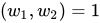
- The generalized spectrogram is real if and only if for some .







References
- Class notes of Time frequency analysis and wavelet transform -- from Prof. Jian-Jiun Ding's course website
- P. Boggiatto, G. De Donno, and A. Oliaro, “Two window spectrogram and their integrals," Advances and Applications, vol. 205, pp. 251–268, 2009.
Content Disclaimer
Informasi ini disarikan dari Wikipedia dan disajikan kembali untuk tujuan edukasi. Konten tersedia di bawah lisensi CC BY-SA 3.0. Kami tidak bertanggung jawab atas ketidakakuratan data yang bersumber dari kontribusi publik tersebut.
- The information displayed on this website is sourced in part or in whole from Wikipedia and has been adapted for the purpose of restating it. We strive to provide accurate and relevant information, however:
- There is no guarantee of absolute accuracy. Wikipedia is an open, collaborative project that can be edited by anyone, so information is subject to change.
- It is not intended to constitute professional advice. The content displayed is for informational and educational purposes only. For important decisions (e.g., medical, legal, or financial), please consult a professional.
- Content copyright. Wikipedia is licensed under the Creative Commons Attribution-ShareAlike License (CC BY-SA). This means that content may be reused with appropriate attribution and shared under a similar license.
- Responsible use. Any risk arising from the use of information from this website is entirely the responsibility of the user.