Gibbs algorithm
 | This article relies on a single source. (March 2024) |

In statistical mechanics, the Gibbs algorithm, introduced by J. Willard Gibbs in 1902, is a criterion for choosing a probability distribution for the statistical ensemble of microstates of a thermodynamic system by minimizing the average log probability
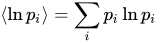
subject to the probability distribution pi satisfying a set of constraints (usually expectation values) corresponding to the known macroscopic quantities.[1] in 1948, Claude Shannon interpreted the negative of this quantity, which he called information entropy, as a measure of the uncertainty in a probability distribution.[1] In 1957, E.T. Jaynes realized that this quantity could be interpreted as missing information about anything, and generalized the Gibbs algorithm to non-equilibrium systems with the principle of maximum entropy and maximum entropy thermodynamics.[1]
Physicists call the result of applying the Gibbs algorithm the Gibbs distribution for the given constraints, most notably Gibbs's grand canonical ensemble for open systems when the average energy and the average number of particles are given. (See also partition function).
This general result of the Gibbs algorithm is then a maximum entropy probability distribution. Statisticians identify such distributions as belonging to exponential families.
References
- ^ a b c Dewar, Roderick C. (2005). "4. Maximum Entropy Production and Non-equilibrium Statistical Mechanics". In Kleidon, A. (ed.). Non-equilibrium thermodynamics and the production of entropy : life, earth, and beyond. Understanding Complex Systems. Berlin: Springer. pp. 41–55. doi:10.1007/11672906_4. ISBN 9783540224952.
 | This article about statistical mechanics is a stub. You can help Wikipedia by adding missing information. |
Content Disclaimer
Informasi ini disarikan dari Wikipedia dan disajikan kembali untuk tujuan edukasi. Konten tersedia di bawah lisensi CC BY-SA 3.0. Kami tidak bertanggung jawab atas ketidakakuratan data yang bersumber dari kontribusi publik tersebut.
- The information displayed on this website is sourced in part or in whole from Wikipedia and has been adapted for the purpose of restating it. We strive to provide accurate and relevant information, however:
- There is no guarantee of absolute accuracy. Wikipedia is an open, collaborative project that can be edited by anyone, so information is subject to change.
- It is not intended to constitute professional advice. The content displayed is for informational and educational purposes only. For important decisions (e.g., medical, legal, or financial), please consult a professional.
- Content copyright. Wikipedia is licensed under the Creative Commons Attribution-ShareAlike License (CC BY-SA). This means that content may be reused with appropriate attribution and shared under a similar license.
- Responsible use. Any risk arising from the use of information from this website is entirely the responsibility of the user.