Hansen's problem

In trigonometry, Hansen's problem is a problem in planar surveying, named after the astronomer Peter Andreas Hansen (1795–1874), who worked on the geodetic survey of Denmark. There are two known points A, B, and two unknown points P1, P2. From P1 and P2 an observer measures the angles made by the lines of sight to each of the other three points. The problem is to find the positions of P1 and P2. See figure; the angles measured are (α1, β1, α2, β2).
Since it involves observations of angles made at unknown points, the problem is an example of resection (as opposed to intersection).
Solution method overview
Define the following angles: As a first step we will solve for φ and ψ. The sum of these two unknown angles is equal to the sum of β1 and β2, yielding the equation
![{\displaystyle {\begin{alignedat}{5}\gamma &=\angle P_{1}AP_{2},&\quad \delta &=\angle P_{1}BP_{2},\\[4pt]\phi &=\angle P_{2}AB,&\quad \psi &=\angle P_{1}BA.\end{alignedat}}}](https://wikimedia.org/api/rest_v1/media/math/render/svg/ec6a2f74eaf24d81a56bc314235f5b33b23740d1)

A second equation can be found more laboriously, as follows. The law of sines yields
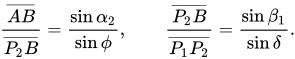
Combining these, we get
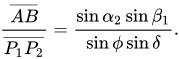
Entirely analogous reasoning on the other side yields
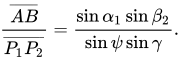
Setting these two equal gives

Using a known trigonometric identity this ratio of sines can be expressed as the tangent of an angle difference:

Where

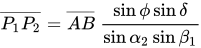
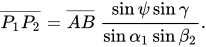
This is the second equation we need. Once we solve the two equations for the two unknowns φ, ψ, we can use either of the two expressions above for to find since AB is known. We can then find all the other segments using the law of sines.[1]


Solution algorithm
We are given four angles (α1, β1, α2, β2) and the distance AB. The calculation proceeds as follows:
- Calculate
- Calculate
- Let and then
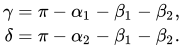
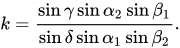

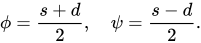
Calculate or equivalently If one of these fractions has a denominator close to zero, use the other one.
See also
References
- ^ Udo Hebisch: Ebene und Sphaerische Trigonometrie, Kapitel 1, Beispiel 4 (2005, 2006)[1] Archived 2016-02-22 at the Wayback Machine
Content Disclaimer
Informasi ini disarikan dari Wikipedia dan disajikan kembali untuk tujuan edukasi. Konten tersedia di bawah lisensi CC BY-SA 3.0. Kami tidak bertanggung jawab atas ketidakakuratan data yang bersumber dari kontribusi publik tersebut.
- The information displayed on this website is sourced in part or in whole from Wikipedia and has been adapted for the purpose of restating it. We strive to provide accurate and relevant information, however:
- There is no guarantee of absolute accuracy. Wikipedia is an open, collaborative project that can be edited by anyone, so information is subject to change.
- It is not intended to constitute professional advice. The content displayed is for informational and educational purposes only. For important decisions (e.g., medical, legal, or financial), please consult a professional.
- Content copyright. Wikipedia is licensed under the Creative Commons Attribution-ShareAlike License (CC BY-SA). This means that content may be reused with appropriate attribution and shared under a similar license.
- Responsible use. Any risk arising from the use of information from this website is entirely the responsibility of the user.