Homological stability
In mathematics, homological stability is any of a number of theorems asserting that the group homology of a series of groups is stable, i.e.,


is independent of n when n is large enough (depending on i). The smallest n such that the maps is an isomorphism is referred to as the stable range. The concept of homological stability was pioneered by Daniel Quillen whose proof technique has been adapted in various situations.[1]

Examples
Examples of such groups include the following:
| group | name |
|---|---|
| symmetric group | |
| braid group | [3] |
| general linear group for (certain) rings R | [4][5] |
| mapping class group of surfaces (n is the genus of the surface) | Harer stability[6] |
| automorphism group of free groups, | [7] |


Applications
In some cases, the homology of the group
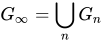
can be computed by other means or is related to other data. For example, the Barratt–Priddy theorem relates the homology of the infinite symmetric group agrees with mapping spaces of spheres. This can also be stated as a relation between the plus construction of and the sphere spectrum. In a similar vein, the homology of is related, via the +-construction, to the algebraic K-theory of R.


References
- ^ Quillen, D. (1973). "Finite generation of the groups Ki of rings of algebraic integers.". Algebraic K-theory, I: Higher K-theories. Lecture Notes in Math. Vol. 341. Springer. pp. 179–198.
- ^ Nakaoka, Minoru (1961). "Homology of the infinite symmetric group". Ann. Math. 2. 73: 229–257. doi:10.2307/1970333.
- ^ Arnol’d, V.I. (1969). "The cohomology ring of the colored braid group". Mathematical Notes. 5 (2): 138–140. doi:10.1007/bf01098313.
- ^ Suslin, A. A. (1982), Stability in algebraic K-theory. Algebraic K-theory, Part I (Oberwolfach, 1980), Lecture Notes in Math., 966, Springer, pp. 304–333
- ^ Van der Kallen, W. (1980). "Homology stability for linear groups" (PDF). Invent. Math. 60: 269–295. doi:10.1007/bf01390018.
- ^ Harer, J. L. (1985). "Stability of the homology of the mapping class groups of orientable surfaces". Annals of Mathematics. 121: 215–249. doi:10.2307/1971172.
- ^ Hatcher, Allen; Vogtmann, Karen (1998). "Cerf theory for graphs". J. London Math. Soc. Series 2. 58 (3): 633–655. doi:10.1112/s0024610798006644.
Content Disclaimer
Informasi ini disarikan dari Wikipedia dan disajikan kembali untuk tujuan edukasi. Konten tersedia di bawah lisensi CC BY-SA 3.0. Kami tidak bertanggung jawab atas ketidakakuratan data yang bersumber dari kontribusi publik tersebut.
- The information displayed on this website is sourced in part or in whole from Wikipedia and has been adapted for the purpose of restating it. We strive to provide accurate and relevant information, however:
- There is no guarantee of absolute accuracy. Wikipedia is an open, collaborative project that can be edited by anyone, so information is subject to change.
- It is not intended to constitute professional advice. The content displayed is for informational and educational purposes only. For important decisions (e.g., medical, legal, or financial), please consult a professional.
- Content copyright. Wikipedia is licensed under the Creative Commons Attribution-ShareAlike License (CC BY-SA). This means that content may be reused with appropriate attribution and shared under a similar license.
- Responsible use. Any risk arising from the use of information from this website is entirely the responsibility of the user.