Intensity of counting processes
 | This article needs more citations. (June 2015) |
The intensity of a counting process is a measure of the rate of change of its predictable part. If a stochastic process is a counting process, then it is a submartingale, and in particular its Doob-Meyer decomposition is

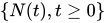

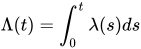
where is a martingale and is a predictable increasing process. is called the cumulative intensity of and it is related to by


- .
Definition
Given probability space and a counting process which is adapted to the filtration , the intensity of is the process defined by the following limit:


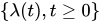
- .
![{\displaystyle \lambda (t)=\lim _{h\downarrow 0}{\frac {1}{h}}\mathbb {E} [N(t+h)-N(t)|{\mathcal {F}}_{t}]}](https://wikimedia.org/api/rest_v1/media/math/render/svg/35c1ea5bcd9dd2af739bbbb622e1220360b5290b)
The right-continuity property of counting processes allows us to take this limit from the right.[1]
Estimation
In statistical learning, the variation between and its estimator can be bounded with the use of oracle inequalities.

If a counting process is restricted to and i.i.d. copies are observed on that interval, , then the least squares functional for the intensity is
![{\displaystyle t\in [0,1]}](https://wikimedia.org/api/rest_v1/media/math/render/svg/31a5c18739ff04858eecc8fec2f53912c348e0e5)



which involves an Ito integral. If the assumption is made that is piecewise constant on , i.e. it depends on a vector of constants and can be written

![{\displaystyle [0,1]}](https://wikimedia.org/api/rest_v1/media/math/render/svg/738f7d23bb2d9642bab520020873cccbef49768d)

- ,
![{\displaystyle \lambda _{\beta }=\sum _{j=1}^{m}\beta _{j}\lambda _{j,m},\;\;\;\;\;\;\lambda _{j,m}={\sqrt {m}}\mathbf {1} _{({\frac {j-1}{m}},{\frac {j}{m}}]}}](https://wikimedia.org/api/rest_v1/media/math/render/svg/3cdf809c64beb720732addfc4438101269ec301b)
where the have a factor of so that they are orthonormal under the standard norm, then by choosing appropriate data-driven weights which depend on a parameter and introducing the weighted norm


- ,
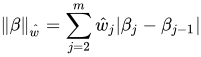
the estimator for can be given:

- .

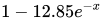
Then, the estimator is just . With these preliminaries, an oracle inequality bounding the norm is as follows: for appropriate choice of ,



with probability greater than or equal to .[2]
References
- ^ Aalen, O. (1978). Nonparametric inference for a family of counting processes. The Annals of Statistics, 6(4):701-726.
- ^ Alaya, E., S. Gaiffas, and A. Guilloux (2014) Learning the intensity of time events with change-points[permanent dead link]
Content Disclaimer
Informasi ini disarikan dari Wikipedia dan disajikan kembali untuk tujuan edukasi. Konten tersedia di bawah lisensi CC BY-SA 3.0. Kami tidak bertanggung jawab atas ketidakakuratan data yang bersumber dari kontribusi publik tersebut.
- The information displayed on this website is sourced in part or in whole from Wikipedia and has been adapted for the purpose of restating it. We strive to provide accurate and relevant information, however:
- There is no guarantee of absolute accuracy. Wikipedia is an open, collaborative project that can be edited by anyone, so information is subject to change.
- It is not intended to constitute professional advice. The content displayed is for informational and educational purposes only. For important decisions (e.g., medical, legal, or financial), please consult a professional.
- Content copyright. Wikipedia is licensed under the Creative Commons Attribution-ShareAlike License (CC BY-SA). This means that content may be reused with appropriate attribution and shared under a similar license.
- Responsible use. Any risk arising from the use of information from this website is entirely the responsibility of the user.