Interpretability logic
Interpretability logics comprise a family of modal logics that extend provability logic to describe interpretability or various related metamathematical properties and relations such as weak interpretability, Π1-conservativity, cointerpretability, tolerance, cotolerance, and arithmetic complexities.
Main contributors to the field are Alessandro Berarducci, Petr Hájek, Konstantin Ignatiev, Giorgi Japaridze, Franco Montagna, Vladimir Shavrukov, Rineke Verbrugge, Albert Visser, and Domenico Zambella.
Examples
Logic ILM
The language of ILM extends that of classical propositional logic by adding the unary modal operator and the binary modal operator (as usual, is defined as ). The arithmetical interpretation of is “ is provable in Peano arithmetic (PA)”, and is understood as “ is interpretable in ”.


- All classical tautologies








- “From and conclude ”
- “From conclude ”.


The completeness of ILM with respect to its arithmetical interpretation was independently proven by Alessandro Berarducci and Vladimir Shavrukov.
Logic TOL
The language of TOL extends that of classical propositional logic by adding the modal operator which is allowed to take any nonempty sequence of arguments. The arithmetical interpretation of is “ is a tolerant sequence of theories”.

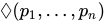

Axioms (with standing for any formulas, for any sequences of formulas, and identified with ⊤):


- All classical tautologies






Rules of inference:
- “From and conclude ”
- “From conclude ”.


The completeness of TOL with respect to its arithmetical interpretation was proven by Giorgi Japaridze.
References
- Giorgi Japaridze and Dick de Jongh, The Logic of Provability. In Handbook of Proof Theory, S. Buss, ed., Elsevier, 1998, pp. 475-546.
Content Disclaimer
Informasi ini disarikan dari Wikipedia dan disajikan kembali untuk tujuan edukasi. Konten tersedia di bawah lisensi CC BY-SA 3.0. Kami tidak bertanggung jawab atas ketidakakuratan data yang bersumber dari kontribusi publik tersebut.
- The information displayed on this website is sourced in part or in whole from Wikipedia and has been adapted for the purpose of restating it. We strive to provide accurate and relevant information, however:
- There is no guarantee of absolute accuracy. Wikipedia is an open, collaborative project that can be edited by anyone, so information is subject to change.
- It is not intended to constitute professional advice. The content displayed is for informational and educational purposes only. For important decisions (e.g., medical, legal, or financial), please consult a professional.
- Content copyright. Wikipedia is licensed under the Creative Commons Attribution-ShareAlike License (CC BY-SA). This means that content may be reused with appropriate attribution and shared under a similar license.
- Responsible use. Any risk arising from the use of information from this website is entirely the responsibility of the user.