Lieb–Liniger model
In physics, the Lieb–Liniger model describes a gas of particles moving in one dimension and satisfying Bose–Einstein statistics. More specifically, it describes a one dimensional Bose gas with Dirac delta interactions. It is named after Elliott H. Lieb and Werner Liniger who introduced the model in 1963.[1] The model was developed to compare and test Nikolay Bogolyubov's theory of a weakly interacting Bose gas.[2] It can be seen as one model in the theory of generalized hydrodynamics.
Definition
Given bosons moving in one-dimension on the -axis defined from with periodic boundary conditions, a state of the N-body system must be described by a many-body wave function . The Hamiltonian, of this model is introduced as


![{\displaystyle [0,L]}](https://wikimedia.org/api/rest_v1/media/math/render/svg/53e3bfad6c2b8297e8c8d2e84ce8f869d69b0d86)


where is the Dirac delta function. The constant denotes the strength of the interaction, represents a repulsive interaction and an attractive interaction.[3] The hard core limit is known as the Tonks–Girardeau gas.[3]


For a collection of bosons, the wave function is unchanged under permutation of any two particles (permutation symmetry), i.e., for all and satisfies for all .





The delta function in the Hamiltonian gives rise to a boundary condition when two coordinates, say and are equal. The condition is that as approaches from above (), the derivative satisfies


- .

Solution


The time-independent Schrödinger equation , is solved by explicit construction of . Since is symmetric it is completely determined by its values in the simplex , defined by the condition that .



The solution can be written in the form of a Bethe ansatz as[2]
- ,

with wave vectors , where the sum is over all permutations, , of the integers , and maps to . The coefficients , as well as the 's are determined by the condition , and this leads to a total energy





- ,

with the amplitudes given by
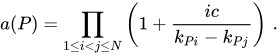
These equations determine in terms of the 's. These lead to equations:[2]

where are integers when is odd and, when is even, they take values . For the ground state the 's satisfy




Thermodynamic limit
![[icon]](https://artikeldigital.com/en/File:Wiki_letter_w_cropped.svg) | This section needs expansion. You can help by adding missing information. (June 2024) |
References
- ^ a b Elliott H. Lieb and Werner Liniger, Exact Analysis of an Interacting Bose Gas. I. The General Solution and the Ground State, Physical Review 130: 1605–1616, 1963
- ^ a b c Lieb, Elliott (2008). "Lieb-Liniger model of a Bose Gas". Scholarpedia. 3 (12): 8712. doi:10.4249/scholarpedia.8712. ISSN 1941-6016.
- ^ a b Eckle, Hans-Peter (29 July 2019). Models of Quantum Matter: A First Course on Integrability and the Bethe Ansatz. Oxford University Press. ISBN 978-0-19-166804-3.
- ^ Dorlas, Teunis C. (1993). "Orthogonality and Completeness of the Bethe Ansatz Eigenstates of the nonlinear Schrödinger model". Communications in Mathematical Physics. 154 (2): 347–376. Bibcode:1993CMaPh.154..347D. doi:10.1007/BF02097001. S2CID 122730941.
Content Disclaimer
Informasi ini disarikan dari Wikipedia dan disajikan kembali untuk tujuan edukasi. Konten tersedia di bawah lisensi CC BY-SA 3.0. Kami tidak bertanggung jawab atas ketidakakuratan data yang bersumber dari kontribusi publik tersebut.
- The information displayed on this website is sourced in part or in whole from Wikipedia and has been adapted for the purpose of restating it. We strive to provide accurate and relevant information, however:
- There is no guarantee of absolute accuracy. Wikipedia is an open, collaborative project that can be edited by anyone, so information is subject to change.
- It is not intended to constitute professional advice. The content displayed is for informational and educational purposes only. For important decisions (e.g., medical, legal, or financial), please consult a professional.
- Content copyright. Wikipedia is licensed under the Creative Commons Attribution-ShareAlike License (CC BY-SA). This means that content may be reused with appropriate attribution and shared under a similar license.
- Responsible use. Any risk arising from the use of information from this website is entirely the responsibility of the user.