Matrix geometric method
In probability theory, the matrix geometric method is a method for the analysis of quasi-birth–death processes, continuous-time Markov chain whose transition rate matrix has a repetitive block structure.[1] The method was developed "largely by Marcel F. Neuts and his students starting around 1975."[2]
Method description
The method requires a transition rate matrix with tridiagonal block structure as follows
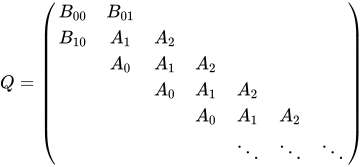
where each of B00, B01, B10, A0, A1 and A2 are matrices. To compute the stationary distribution π writing π Q = 0 the balance equations are considered for sub-vectors πi
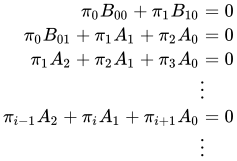
Observe that the relationship

holds where R is the Neuts' rate matrix,[3] which can be computed numerically. Using this we write

which can be solve to find π0 and π1 and therefore iteratively all the πi.
Computation of R
The matrix R can be computed using cyclic reduction[4] or logarithmic reduction.[5][6]
Matrix analytic method
The matrix analytic method is a more complicated version of the matrix geometric solution method used to analyse models with block M/G/1 matrices.[7] Such models are harder because no relationship like πi = π1 Ri – 1 used above holds.[8]
External links
- Performance Modelling and Markov Chains (part 2) by William J. Stewart at 7th International School on Formal Methods for the Design of Computer, Communication and Software Systems: Performance Evaluation
References
- ^ Harrison, Peter G.; Patel, Naresh M. (1992). Performance Modelling of Communication Networks and Computer Architectures. Addison-Wesley. pp. 317–322. ISBN 0-201-54419-9.
- ^ Asmussen, S. R. (2003). "Random Walks". Applied Probability and Queues. Stochastic Modelling and Applied Probability. Vol. 51. pp. 220–243. doi:10.1007/0-387-21525-5_8. ISBN 978-0-387-00211-8.
- ^ Ramaswami, V. (1990). "A duality theorem for the matrix paradigms in queueing theory". Communications in Statistics. Stochastic Models. 6: 151–161. doi:10.1080/15326349908807141.
- ^ Bini, D.; Meini, B. (1996). "On the Solution of a Nonlinear Matrix Equation Arising in Queueing Problems". SIAM Journal on Matrix Analysis and Applications. 17 (4): 906. doi:10.1137/S0895479895284804.
- ^ Latouche, Guy; Ramaswami, V. (1993). "A Logarithmic Reduction Algorithm for Quasi-Birth-Death Processes". Journal of Applied Probability. 30 (3). Applied Probability Trust: 650–674. JSTOR 3214773.
- ^ Pérez, J. F.; Van Houdt, B. (2011). "Quasi-birth-and-death processes with restricted transitions and its applications" (PDF). Performance Evaluation. 68 (2): 126. doi:10.1016/j.peva.2010.04.003. hdl:10067/859850151162165141.
- ^ Alfa, A. S.; Ramaswami, V. (2011). "Matrix Analytic Method: Overview and History". Wiley Encyclopedia of Operations Research and Management Science. doi:10.1002/9780470400531.eorms0631. ISBN 9780470400531.
- ^ Bolch, Gunter; Greiner, Stefan; de Meer, Hermann; Trivedi, Kishor Shridharbhai (2006). Queueing Networks and Markov Chains: Modeling and Performance Evaluation with Computer Science Applications (2 ed.). John Wiley & Sons, Inc. p. 259. ISBN 0471565253.
| Single queueing nodes | |
|---|---|
| Arrival processes | |
| Queueing networks | |
| Service policies | |
| Key concepts | |
| Limit theorems | |
| Extensions | |
| Information systems | |

 | This probability-related article is a stub. You can help Wikipedia by adding missing information. |
Content Disclaimer
Informasi ini disarikan dari Wikipedia dan disajikan kembali untuk tujuan edukasi. Konten tersedia di bawah lisensi CC BY-SA 3.0. Kami tidak bertanggung jawab atas ketidakakuratan data yang bersumber dari kontribusi publik tersebut.
- The information displayed on this website is sourced in part or in whole from Wikipedia and has been adapted for the purpose of restating it. We strive to provide accurate and relevant information, however:
- There is no guarantee of absolute accuracy. Wikipedia is an open, collaborative project that can be edited by anyone, so information is subject to change.
- It is not intended to constitute professional advice. The content displayed is for informational and educational purposes only. For important decisions (e.g., medical, legal, or financial), please consult a professional.
- Content copyright. Wikipedia is licensed under the Creative Commons Attribution-ShareAlike License (CC BY-SA). This means that content may be reused with appropriate attribution and shared under a similar license.
- Responsible use. Any risk arising from the use of information from this website is entirely the responsibility of the user.