Morphological gradient
In mathematical morphology and digital image processing, a morphological gradient is the difference between the dilation and the erosion of a given image. It is an image where each pixel value (typically non-negative) indicates the contrast intensity in the close neighborhood of that pixel. It is useful for edge detection and segmentation applications.
Mathematical definition and types
Let be a grayscale image, mapping points from a Euclidean space or discrete grid E (such as R2 or Z2) into the real line. Let be a grayscale structuring element. Usually, b is symmetric and has short-support, e.g.,


- .
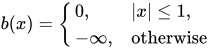
Then, the morphological gradient of f is given by:
- ,

where and denote the dilation and the erosion, respectively.


An internal gradient is given by:
- ,

and an external gradient is given by:
- .

The internal and external gradients are "thinner" than the gradient, but the gradient peaks are located on the edges, whereas the internal and external ones are located at each side of the edges. Notice that .

If , then all the three gradients have non-negative values at all pixels.

References
- Image Analysis and Mathematical Morphology by Jean Serra, ISBN 0-12-637240-3 (1982)
- Image Analysis and Mathematical Morphology, Volume 2: Theoretical Advances by Jean Serra, ISBN 0-12-637241-1 (1988)
- An Introduction to Morphological Image Processing by Edward R. Dougherty, ISBN 0-8194-0845-X (1992)
External links
- Morphological gradients, Centre de Morphologie Mathématique, École_des_Mines_de_Paris
 | This computer graphics–related article is a stub. You can help Wikipedia by adding missing information. |
 | This computer science article is a stub. You can help Wikipedia by adding missing information. |
Content Disclaimer
Informasi ini disarikan dari Wikipedia dan disajikan kembali untuk tujuan edukasi. Konten tersedia di bawah lisensi CC BY-SA 3.0. Kami tidak bertanggung jawab atas ketidakakuratan data yang bersumber dari kontribusi publik tersebut.
- The information displayed on this website is sourced in part or in whole from Wikipedia and has been adapted for the purpose of restating it. We strive to provide accurate and relevant information, however:
- There is no guarantee of absolute accuracy. Wikipedia is an open, collaborative project that can be edited by anyone, so information is subject to change.
- It is not intended to constitute professional advice. The content displayed is for informational and educational purposes only. For important decisions (e.g., medical, legal, or financial), please consult a professional.
- Content copyright. Wikipedia is licensed under the Creative Commons Attribution-ShareAlike License (CC BY-SA). This means that content may be reused with appropriate attribution and shared under a similar license.
- Responsible use. Any risk arising from the use of information from this website is entirely the responsibility of the user.