Mott polynomials
 | This article has multiple issues. Please help improve it or discuss these issues on the talk page. (Learn how and when to remove these messages)
|


In mathematics the Mott polynomials sn(x) are polynomials given by the exponential generating function:

Introduction
They were introduced by Nevill Francis Mott who applied them to a problem in the theory of electrons.[1]
Logic
Because the factor in the exponential has the power series
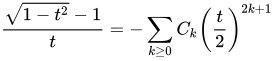
in terms of Catalan numbers , the coefficient in front of of the polynomial can be written as


- , according to the general formula for generalized Appell polynomials, where the sum is over all compositions of into positive odd integers. The empty product appearing for equals 1. Special values, where all contributing Catalan numbers equal 1, are
![{\displaystyle [x^{k}]s_{n}(x)=(-1)^{k}{\frac {n!}{k!2^{n}}}\sum _{n=l_{1}+l_{2}+\cdots +l_{k}}C_{(l_{1}-1)/2}C_{(l_{2}-1)/2}\cdots C_{(l_{k}-1)/2}}](https://wikimedia.org/api/rest_v1/media/math/render/svg/088de149eed46355ea0fbbb8e777c707a7408137)



![{\displaystyle [x^{n}]s_{n}(x)={\frac {(-1)^{n}}{2^{n}}}.}](https://wikimedia.org/api/rest_v1/media/math/render/svg/5113b5ad2110fb45b409df39fa94cdc8c7d68bbb)
![{\displaystyle [x^{n-2}]s_{n}(x)={\frac {(-1)^{n}n(n-1)(n-2)}{2^{n}}}.}](https://wikimedia.org/api/rest_v1/media/math/render/svg/6c113c8fd4cab6cb46f048148ea780ec90ef9020)
By differentiation the recurrence for the first derivative becomes

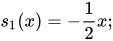
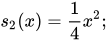
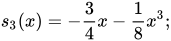
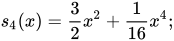
The first few of them are (sequence A137378 in the OEIS)



Sheffer sequence
The polynomials sn(x) form the associated Sheffer sequence for –2t/(1–t2)[2]
Generalized hypergeometric function
An explicit expression for them in terms of the generalized hypergeometric function 3F0:[3]

References
- ^ Mott, N. F. (1932). "The Polarisation of Electrons by Double Scattering". Proceedings of the Royal Society of London. Series A, Containing Papers of a Mathematical and Physical Character. 135 (827): 429–458 [442]. Bibcode:1932RSPSA.135..429M. doi:10.1098/rspa.1932.0044. ISSN 0950-1207. JSTOR 95868.
- ^ Roman, Steven (1984). The umbral calculus. Pure and Applied Mathematics. Vol. 111. London: Academic Press Inc. [Harcourt Brace Jovanovich Publishers]. p. 130. ISBN 978-0-12-594380-2. MR 0741185. Reprinted by Dover, 2005.
- ^ Erdélyi, Arthur; Magnus, Wilhelm; Oberhettinger, Fritz [in German]; Tricomi, Francesco G. (1955). Higher transcendental functions. Vol. III. New York-Toronto-London: McGraw-Hill Book Company, Inc. p. 251. MR 0066496.
Content Disclaimer
Informasi ini disarikan dari Wikipedia dan disajikan kembali untuk tujuan edukasi. Konten tersedia di bawah lisensi CC BY-SA 3.0. Kami tidak bertanggung jawab atas ketidakakuratan data yang bersumber dari kontribusi publik tersebut.
- The information displayed on this website is sourced in part or in whole from Wikipedia and has been adapted for the purpose of restating it. We strive to provide accurate and relevant information, however:
- There is no guarantee of absolute accuracy. Wikipedia is an open, collaborative project that can be edited by anyone, so information is subject to change.
- It is not intended to constitute professional advice. The content displayed is for informational and educational purposes only. For important decisions (e.g., medical, legal, or financial), please consult a professional.
- Content copyright. Wikipedia is licensed under the Creative Commons Attribution-ShareAlike License (CC BY-SA). This means that content may be reused with appropriate attribution and shared under a similar license.
- Responsible use. Any risk arising from the use of information from this website is entirely the responsibility of the user.