Neutral vector
In statistics, and specifically in the study of the Dirichlet distribution, a neutral vector of random variables is one that exhibits a particular type of statistical independence amongst its elements.[1] In particular, when elements of the random vector must add up to certain sum, then an element in the vector is neutral with respect to the others if the distribution of the vector created by expressing the remaining elements as proportions of their total is independent of the element that was omitted.
Definition
A single element of a random vector is neutral if the relative proportions of all the other elements are independent of .


Formally, consider the vector of random variables

where

The values are interpreted as lengths whose sum is unity. In a variety of contexts, it is often desirable to eliminate a proportion, say , and consider the distribution of the remaining intervals within the remaining length. The first element of , viz is defined as neutral if is statistically independent of the vector



Variable is neutral if is independent of the remaining interval: that is, being independent of

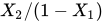

Thus , viewed as the first element of , is neutral.

In general, variable is neutral if is independent of



Complete neutrality
A vector for which each element is neutral is completely neutral.
If is drawn from a Dirichlet distribution, then is completely neutral. In 1980, James and Mosimann[2] showed that the Dirichlet distribution is characterised by neutrality.

See also
References
- ^ Connor, R. J.; Mosimann, J. E. (1969). "Concepts of Independence for Proportions with a Generalization of the Dirichlet Distribution". Journal of the American Statistical Association. 64 (325): 194–206. doi:10.2307/2283728.
- ^ James, Ian R.; Mosimann, James E (1980). "A new characterization of the Dirichlet distribution through neutrality". The Annals of Statistics. 8 (1): 183–189. doi:10.1214/aos/1176344900.
Content Disclaimer
Informasi ini disarikan dari Wikipedia dan disajikan kembali untuk tujuan edukasi. Konten tersedia di bawah lisensi CC BY-SA 3.0. Kami tidak bertanggung jawab atas ketidakakuratan data yang bersumber dari kontribusi publik tersebut.
- The information displayed on this website is sourced in part or in whole from Wikipedia and has been adapted for the purpose of restating it. We strive to provide accurate and relevant information, however:
- There is no guarantee of absolute accuracy. Wikipedia is an open, collaborative project that can be edited by anyone, so information is subject to change.
- It is not intended to constitute professional advice. The content displayed is for informational and educational purposes only. For important decisions (e.g., medical, legal, or financial), please consult a professional.
- Content copyright. Wikipedia is licensed under the Creative Commons Attribution-ShareAlike License (CC BY-SA). This means that content may be reused with appropriate attribution and shared under a similar license.
- Responsible use. Any risk arising from the use of information from this website is entirely the responsibility of the user.