Optothermal stability
Optothermal stability describes the rate at which an optical element distorts due to a changing thermal environment. A changing thermal environment can cause an optic to bend due to either 1) changing thermal gradients on the optic and a non-zero coefficient of thermal expansion, or 2) coefficient of thermal expansion gradients in an optic and an average temperature change. [1] Therefore, optothermal stability is an issue for optics that are present in a changing thermal environment. For example, a space telescope will experience variable heat loads from changes in spacecraft attitude, solar flux, planetary albedo, and planetary infrared emissions. Optothermal stability can be important when measuring the surface figure of optics, because thermal changes are typically low frequency (diurnal or HVAC cycling) which makes it difficult to use measurement averaging (commonly used for other error types) to remove errors. Also, optothermal stability is important for optical systems which require a high level of stability such as those that use a coronagraph.[2]
Material characterization
Material characterization numbers have been mathematically derived to describe the rate at which a material deforms due to an external thermal input. There is a distinction between wavefront stability (dynamic) and wavefront error (static). A higher Massive Optothermal Stability (MOS) and Optothermal Stability (OS) number will result in greater stability.[3] As shown in the equation, MOS increases with density. Because added weight is undesirable for non-thermal reasons, especially in spaceflight applications, both MOS and OS are defined below:
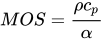

Where ρ, cp, α are density, specific heat, and the coefficient of thermal expansion respectively.
See also
References
- ^ Brooks, Thomas (August 6, 2017). "Modeling the Extremely Lightweight Zerodur Mirror (ELZM) Thermal Soak Test". SPIE Proceedings. 10398: https://ntrs.nasa.gov/archive/nasa/casi.ntrs.nasa.gov/20170009042.pdf.
- ^ Brooks, Thomas (August 6, 2017). "Predictive thermal control applied to HabEx". SPIE Proceedings. 10398: https://ntrs.nasa.gov/archive/nasa/casi.ntrs.nasa.gov/20170009034.pdf.
- ^ Brooks, Thomas (September 23, 2015). "Advanced Mirror Technology Development (AMTD) thermal trade studies". SPIE Proceedings. 9577: https://ntrs.nasa.gov/archive/nasa/casi.ntrs.nasa.gov/20150019495.pdf.
Content Disclaimer
Informasi ini disarikan dari Wikipedia dan disajikan kembali untuk tujuan edukasi. Konten tersedia di bawah lisensi CC BY-SA 3.0. Kami tidak bertanggung jawab atas ketidakakuratan data yang bersumber dari kontribusi publik tersebut.
- The information displayed on this website is sourced in part or in whole from Wikipedia and has been adapted for the purpose of restating it. We strive to provide accurate and relevant information, however:
- There is no guarantee of absolute accuracy. Wikipedia is an open, collaborative project that can be edited by anyone, so information is subject to change.
- It is not intended to constitute professional advice. The content displayed is for informational and educational purposes only. For important decisions (e.g., medical, legal, or financial), please consult a professional.
- Content copyright. Wikipedia is licensed under the Creative Commons Attribution-ShareAlike License (CC BY-SA). This means that content may be reused with appropriate attribution and shared under a similar license.
- Responsible use. Any risk arising from the use of information from this website is entirely the responsibility of the user.