Pair potential
In physics, a pair potential is a function that describes the potential energy of two interacting objects solely as a function of the distance between them.[1]
Some interactions, like Coulomb's law in electrodynamics or Newton's law of universal gravitation in mechanics naturally have this form for simple spherical objects. For other types of more complex interactions or objects it is useful and common to approximate the interaction by a pair potential, for example interatomic potentials in physics and computational chemistry that use approximations like the Lennard-Jones and Morse potentials.
Functional form
The total energy of a system of objects at positions , that interact through pair potential is given by


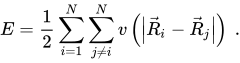
Equivalently, this can be expressed as
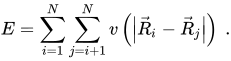
This expression uses the fact that interaction is symmetric between particles and . It also avoids self-interaction by not including the case where .


Potential range
A fundamental property of a pair potential is its range. It is expected that pair potentials go to zero for infinite distance as particles that are too far apart do not interact. In some cases the potential goes quickly to zero and the interaction for particles that are beyond a certain distance can be assumed to be zero, these are said to be short-range potentials. Other potentials, like the Coulomb or gravitational potential, are long range: they go slowly to zero and the contribution of particles at long distances still contributes to the total energy.
Computational cost
The total energy expression for pair potentials is quite simple to use for analytical and computational work. It has some limitations however, as the computational cost is proportional to the square of number of particles. This might be prohibitively expensive when the interaction between large groups of objects needs to be calculated.
For short-range potentials the sum can be restricted only to include particles that are close, reducing the cost to linearly proportional to the number of particles.
Infinitely periodic systems
In some cases it is necessary to calculate the interaction between an infinite number of particles arranged in a periodic pattern.
Beyond pair potentials
An example of a potential energy function that is not a pair potential is the three-body Axilrod-Teller potential. Another example is the Stillinger-Weber potential for silicon, which includes the angle in a triangle of silicon atoms as an input parameter.[2][3]
Common pair potentials
Some commonly used pair potentials are listed below.
- Hard Sphere potential
- Sutherland potential
- Buckingham (or exp-6) potential
- Mie potential
- Lennard-Jones (12-6) potential
- Stockmayer potential
- Coulomb potential
- Yukawa potential
- Morse potential
References
- ^ Pei, Jun; Song, Lin Frank; Merz Jr., Kenneth M. (June 19, 2020). "Pair Potentials as Machine Learning Features". J. Chem. Theory Comput. 16 (8): 5385–5400. doi:10.1021/acs.jctc.9b01246. PMID 32559380. S2CID 219947826. Retrieved 26 July 2022.
- ^ Stillinger, Frank H.; Weber, Thomas A. (15 April 1985). "Computer simulation of local order in condensed phases of silicon". Physical Review B. 31 (8): 5262–5271. Bibcode:1985PhRvB..31.5262S. doi:10.1103/PhysRevB.31.5262. PMID 9936488. Retrieved 26 July 2022.
- ^ Stillinger, Frank H.; Weber, Thomas A. (15 January 1986). "Erratum: Computer simulation of local order in condensed phases of silicon [Phys. Rev. B 31, 5262 (1985)]". Physical Review B. 33 (2): 1451. Bibcode:1986PhRvB..33.1451S. doi:10.1103/PhysRevB.33.1451. PMID 9938428.
| Theory |  | |
|---|---|---|
| Statistical thermodynamics | ||
| Models | ||
| Mathematical approaches | ||
| Critical phenomena | ||
| Entropy | ||
| Applications | ||
Content Disclaimer
Informasi ini disarikan dari Wikipedia dan disajikan kembali untuk tujuan edukasi. Konten tersedia di bawah lisensi CC BY-SA 3.0. Kami tidak bertanggung jawab atas ketidakakuratan data yang bersumber dari kontribusi publik tersebut.
- The information displayed on this website is sourced in part or in whole from Wikipedia and has been adapted for the purpose of restating it. We strive to provide accurate and relevant information, however:
- There is no guarantee of absolute accuracy. Wikipedia is an open, collaborative project that can be edited by anyone, so information is subject to change.
- It is not intended to constitute professional advice. The content displayed is for informational and educational purposes only. For important decisions (e.g., medical, legal, or financial), please consult a professional.
- Content copyright. Wikipedia is licensed under the Creative Commons Attribution-ShareAlike License (CC BY-SA). This means that content may be reused with appropriate attribution and shared under a similar license.
- Responsible use. Any risk arising from the use of information from this website is entirely the responsibility of the user.