Parbelos




The parbelos is a figure similar to the arbelos but instead of three half circles it uses three parabola segments. More precisely the parbelos consists of three parabola segments, that have a height that is one fourth of the width at their bases. The two smaller parabola segments are placed next to each other with their bases on a common line and the largest parabola is placed over the two smaller ones such that its width is the sum of the widths of the smaller ones (see graphic).
The parbelos has a number of properties which are somewhat similar or even identical to the properties of the Arbelos. For instance, the following two properties are identical to those of the arbelos:[1]
- The arc length of the outer parabola is equal to the sum of the arc lengths of the inner parabolas.
- In a nested arbelos construction with the inner parabola segments being arbeloses themselves the two innermost parabola segments being adjacent to the cusp of the outer arbelos are congruent, that is of equal size.
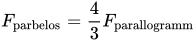
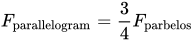
The quadrilateral formed by the inner cusp and the midpoints of the three parabola arcs is a parallelogram the area of which relates to the area of the parbelos as follows:[1]

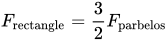
The four tangents at the three cusps of the parabola intersect in four points, which form a rectangle being called the tangent rectangle. The circumcircle of the tangent rectangle intersects the base side of the outer parabola segment in its midpoint, which is the focus of the outer parabola. One diagonal of the tangent rectangle lies on a tangent to the outer parabola and its common point with it is identical to its point of intersection with perpendicular to the base at the inner cusp. For the area of the tangent rectangle the following equation holds:[2]
References
- ^ a b Michał Różański, Alicja Samulewicz, Marcin Szweda, Roman Wituła: "Variations on the arbelos". In: Journal of Applied Mathematics and Computational Mechanics, Volume 16, Issue 2, 2017, pp. 123-133 (online copy)
- ^ Jonathan Sondow: "The Parbelos, a Parabolic Analog of the Arbelos". In: The American Mathematical Monthly, Vol. 120, No. 10 (December 2013), pp. 929-935 (JSTOR)
Further reading
- Emmanuel Tsukerman: "Solution of Sondow’s Problem: A Synthetic Proof of the Tangency Property of the Parbelos". In: The American Mathematical Monthly, Vol. 121, No. 5 (May 2014), pp. 438-443
- Antonio M. Oller-Marcén: "The f-belos". In: Forum Geometricorum, 13 (2013), pp. 103–111 (online copy)
- Viktorija Ternar: Arbelos, parabelos in f-belos (master thesis, University of Maribor, 2015)

Content Disclaimer
Informasi ini disarikan dari Wikipedia dan disajikan kembali untuk tujuan edukasi. Konten tersedia di bawah lisensi CC BY-SA 3.0. Kami tidak bertanggung jawab atas ketidakakuratan data yang bersumber dari kontribusi publik tersebut.
- The information displayed on this website is sourced in part or in whole from Wikipedia and has been adapted for the purpose of restating it. We strive to provide accurate and relevant information, however:
- There is no guarantee of absolute accuracy. Wikipedia is an open, collaborative project that can be edited by anyone, so information is subject to change.
- It is not intended to constitute professional advice. The content displayed is for informational and educational purposes only. For important decisions (e.g., medical, legal, or financial), please consult a professional.
- Content copyright. Wikipedia is licensed under the Creative Commons Attribution-ShareAlike License (CC BY-SA). This means that content may be reused with appropriate attribution and shared under a similar license.
- Responsible use. Any risk arising from the use of information from this website is entirely the responsibility of the user.