Partial residual plot
 | This article includes a list of references, related reading, or external links, but its sources remain unclear because it lacks inline citations. (February 2022) |
In applied statistics, a partial residual plot is a graphical technique that attempts to show the relationship between a given independent variable and the response variable given that other independent variables are also in the model.
Background
When performing a linear regression with a single independent variable, a scatter plot of the response variable against the independent variable provides a good indication of the nature of the relationship. If there is more than one independent variable, things become more complicated. Although it can still be useful to generate scatter plots of the response variable against each of the independent variables, this does not take into account the effect of the other independent variables in the model.
Definition
Partial residual plots are formed as

where
- Residuals = residuals from the full model,
- = regression coefficient from the i-th independent variable in the full model,
- Xi = the i-th independent variable.

Partial residual plots are widely discussed in the regression diagnostics literature (e.g., see the References section below). Although they can often be useful, they can also fail to indicate the proper relationship. In particular, if Xi is highly correlated with any of the other independent variables, the variance indicated by the partial residual plot can be much less than the actual variance. These issues are discussed in more detail in the references given below.
CCPR plot
The CCPR (component and component-plus-residual) plot is a refinement of the partial residual plot, adding
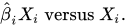
This is the "component" part of the plot and is intended to show where the "fitted line" would lie.
See also
- Partial regression plot
- Partial leverage plot
- Variance inflation factors for a multi-linear fit.
References
- Tom Ryan (1997). Modern Regression Methods. John Wiley.
- Neter, Wasserman, and Kutner (1990). Applied Linear Statistical Models (3rd ed.). Irwin.
{{cite book}}: CS1 maint: multiple names: authors list (link) - Draper and Smith (1998). Applied Regression Analysis (3rd ed.). John Wiley.
- Cook and Weisberg (1982). Residuals and Influence in Regression. Chapman and Hall.
- Belsley, Kuh, and Welsch (1980). Regression Diagnostics. John Wiley.
{{cite book}}: CS1 maint: multiple names: authors list (link) - Paul Velleman; Roy Welsch (November 1981). "Efficient Computing of Regression Diagnostics". The American Statistician. 35 (4). American Statistical Association: 234–242. doi:10.2307/2683296. JSTOR 2683296.
- Chatterjee, Samprit; Hadi, Ali S. (2009). Sensitivity Analysis in Linear Regression. John Wiley & Sons. pp. 54–59. ISBN 9780470317426.
External links
 This article incorporates public domain material from the National Institute of Standards and Technology
Content Disclaimer
Informasi ini disarikan dari Wikipedia dan disajikan kembali untuk tujuan edukasi. Konten tersedia di bawah lisensi CC BY-SA 3.0. Kami tidak bertanggung jawab atas ketidakakuratan data yang bersumber dari kontribusi publik tersebut.
- The information displayed on this website is sourced in part or in whole from Wikipedia and has been adapted for the purpose of restating it. We strive to provide accurate and relevant information, however:
- There is no guarantee of absolute accuracy. Wikipedia is an open, collaborative project that can be edited by anyone, so information is subject to change.
- It is not intended to constitute professional advice. The content displayed is for informational and educational purposes only. For important decisions (e.g., medical, legal, or financial), please consult a professional.
- Content copyright. Wikipedia is licensed under the Creative Commons Attribution-ShareAlike License (CC BY-SA). This means that content may be reused with appropriate attribution and shared under a similar license.
- Responsible use. Any risk arising from the use of information from this website is entirely the responsibility of the user.