Plane–plane intersection

In geometry, the intersection of two planes in three-dimensional space is a line or the empty set for parallel planes.
Formulation
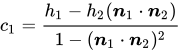
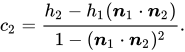
The line of intersection between two planes and where are normalized is given by




where
Derivation
This is found by noticing that the line must be perpendicular to both plane normals, and so parallel to their cross product (this cross product is zero if and only if the planes are parallel, and are therefore non-intersecting or entirely coincident).

The remainder of the expression is arrived at by finding an arbitrary point on the line. To do so, consider that any point in space may be written as , since is a basis. We wish to find a point which is on both planes (i.e. on their intersection), so insert this equation into each of the equations of the planes to get two simultaneous equations which can be solved for and .




If we further assume that and are orthonormal then the closest point on the line of intersection to the origin is . If that is not the case, then a more complex procedure must be used.[1]



Dihedral angle
Given two intersecting planes described by and , the dihedral angle between them is defined to be the angle between their normal directions:




References
- ^ Plane-Plane Intersection - from Wolfram MathWorld. Mathworld.wolfram.com. Retrieved 2013-08-20.
Content Disclaimer
Informasi ini disarikan dari Wikipedia dan disajikan kembali untuk tujuan edukasi. Konten tersedia di bawah lisensi CC BY-SA 3.0. Kami tidak bertanggung jawab atas ketidakakuratan data yang bersumber dari kontribusi publik tersebut.
- The information displayed on this website is sourced in part or in whole from Wikipedia and has been adapted for the purpose of restating it. We strive to provide accurate and relevant information, however:
- There is no guarantee of absolute accuracy. Wikipedia is an open, collaborative project that can be edited by anyone, so information is subject to change.
- It is not intended to constitute professional advice. The content displayed is for informational and educational purposes only. For important decisions (e.g., medical, legal, or financial), please consult a professional.
- Content copyright. Wikipedia is licensed under the Creative Commons Attribution-ShareAlike License (CC BY-SA). This means that content may be reused with appropriate attribution and shared under a similar license.
- Responsible use. Any risk arising from the use of information from this website is entirely the responsibility of the user.