Radial basis function kernel
In machine learning, the radial basis function kernel, or RBF kernel, is a popular kernel function used in various kernelized learning algorithms. In particular, it is commonly used in support vector machine classification.[1]
The RBF kernel on two samples , represented as feature vectors in some input space, is defined as[2]

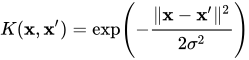
may be recognized as the squared Euclidean distance between the two feature vectors. is a free parameter. An equivalent definition involves a parameter :



Since the value of the RBF kernel decreases with distance and ranges between zero (in the infinite-distance limit) and one (when x = x'), it has a ready interpretation as a similarity measure.[2] The feature space of the kernel has an infinite number of dimensions; for , its expansion using the multinomial theorem is:[3]

![{\displaystyle {\begin{alignedat}{2}\exp \left(-{\frac {1}{2}}\|\mathbf {x} -\mathbf {x'} \|^{2}\right)&=\exp \left({\frac {2}{2}}\mathbf {x} ^{\top }\mathbf {x'} -{\frac {1}{2}}\|\mathbf {x} \|^{2}-{\frac {1}{2}}\|\mathbf {x'} \|^{2}\right)\\[5pt]&=\exp \left(\mathbf {x} ^{\top }\mathbf {x'} \right)\exp \left(-{\frac {1}{2}}\|\mathbf {x} \|^{2}\right)\exp \left(-{\frac {1}{2}}\|\mathbf {x'} \|^{2}\right)\\[5pt]&=\sum _{j=0}^{\infty }{\frac {(\mathbf {x} ^{\top }\mathbf {x'} )^{j}}{j!}}\exp \left(-{\frac {1}{2}}\|\mathbf {x} \|^{2}\right)\exp \left(-{\frac {1}{2}}\|\mathbf {x'} \|^{2}\right)\\[5pt]&=\sum _{j=0}^{\infty }\quad \sum _{n_{1}+n_{2}+\dots +n_{k}=j}\exp \left(-{\frac {1}{2}}\|\mathbf {x} \|^{2}\right){\frac {x_{1}^{n_{1}}\cdots x_{k}^{n_{k}}}{\sqrt {n_{1}!\cdots n_{k}!}}}\exp \left(-{\frac {1}{2}}\|\mathbf {x'} \|^{2}\right){\frac {{x'}_{1}^{n_{1}}\cdots {x'}_{k}^{n_{k}}}{\sqrt {n_{1}!\cdots n_{k}!}}}\\[5pt]&=\langle \varphi (\mathbf {x} ),\varphi (\mathbf {x'} )\rangle \end{alignedat}}}](https://wikimedia.org/api/rest_v1/media/math/render/svg/c42c51e11b675698e01290de18306bcb7acc613f)
where ,



Approximations
Because support vector machines and other models employing the kernel trick do not scale well to large numbers of training samples or large numbers of features in the input space, several approximations to the RBF kernel (and similar kernels) have been introduced.[4] Typically, these take the form of a function z that maps a single vector to a vector of higher dimensionality, approximating the kernel:

where is the implicit mapping embedded in the RBF kernel.

Fourier random features
One way to construct such a z is to randomly sample from the Fourier transformation of the kernel[5]where are independent samples from the normal distribution .
![{\displaystyle \varphi (x)={\frac {1}{\sqrt {D}}}[\cos \langle w_{1},x\rangle ,\sin \langle w_{1},x\rangle ,\ldots ,\cos \langle w_{D},x\rangle ,\sin \langle w_{D},x\rangle ]^{T}}](https://wikimedia.org/api/rest_v1/media/math/render/svg/1ebebe5193c52efc25a749492cf0269cd44e7f0d)


Theorem:
![{\displaystyle \operatorname {E} [\langle \varphi (x),\varphi (y)\rangle ]=e^{\|x-y\|^{2}/(2\sigma ^{2})}.}](https://wikimedia.org/api/rest_v1/media/math/render/svg/e2cc6c1d5eada384ef6b1f2a462dfa2089921bfb)
Proof: It suffices to prove the case of . Use the trigonometric identity , the spherical symmetry of Gaussian distribution, then evaluate the integral


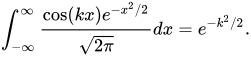
Theorem: . (Appendix A.2[6]).
![{\displaystyle \operatorname {Var} [\langle \varphi (x),\varphi (y)\rangle ]=O(D^{-1})}](https://wikimedia.org/api/rest_v1/media/math/render/svg/e8ab3082dbba4fa920eee2c462249655c7908dc0)
Nyström method
Another approach uses the Nyström method to approximate the eigendecomposition of the Gram matrix K, using only a random sample of the training set.[7]
See also
- Gaussian function
- Kernel (statistics)
- Polynomial kernel
- Radial basis function
- Radial basis function network
- Obst kernel network
References
- ^ Chang, Yin-Wen; Hsieh, Cho-Jui; Chang, Kai-Wei; Ringgaard, Michael; Lin, Chih-Jen (2010). "Training and testing low-degree polynomial data mappings via linear SVM". Journal of Machine Learning Research. 11: 1471–1490.
- ^ a b Jean-Philippe Vert, Koji Tsuda, and Bernhard Schölkopf (2004). "A primer on kernel methods". Kernel Methods in Computational Biology.
- ^ Shashua, Amnon (2009). "Introduction to Machine Learning: Class Notes 67577". arXiv:0904.3664v1 [cs.LG].
- ^ Andreas Müller (2012). Kernel Approximations for Efficient SVMs (and other feature extraction methods).
- ^ Rahimi, Ali; Recht, Benjamin (2007). "Random Features for Large-Scale Kernel Machines". Advances in Neural Information Processing Systems. 20. Curran Associates, Inc.
- ^ Peng, Hao; Pappas, Nikolaos; Yogatama, Dani; Schwartz, Roy; Smith, Noah A.; Kong, Lingpeng (2021-03-19). "Random Feature Attention". arXiv:2103.02143 [cs.CL].
- ^ C.K.I. Williams; M. Seeger (2001). "Using the Nyström method to speed up kernel machines". Advances in Neural Information Processing Systems. 13.
Content Disclaimer
Informasi ini disarikan dari Wikipedia dan disajikan kembali untuk tujuan edukasi. Konten tersedia di bawah lisensi CC BY-SA 3.0. Kami tidak bertanggung jawab atas ketidakakuratan data yang bersumber dari kontribusi publik tersebut.
- The information displayed on this website is sourced in part or in whole from Wikipedia and has been adapted for the purpose of restating it. We strive to provide accurate and relevant information, however:
- There is no guarantee of absolute accuracy. Wikipedia is an open, collaborative project that can be edited by anyone, so information is subject to change.
- It is not intended to constitute professional advice. The content displayed is for informational and educational purposes only. For important decisions (e.g., medical, legal, or financial), please consult a professional.
- Content copyright. Wikipedia is licensed under the Creative Commons Attribution-ShareAlike License (CC BY-SA). This means that content may be reused with appropriate attribution and shared under a similar license.
- Responsible use. Any risk arising from the use of information from this website is entirely the responsibility of the user.