Random recursive tree
In probability theory, a random recursive tree is a rooted tree chosen uniformly at random from the recursive trees with a given number of vertices.
Definition and generation
In a recursive tree with vertices, the vertices are labeled by the numbers from to , and the labels must decrease along any path to the root of the tree. These trees are unordered, in the sense that there is no distinguished ordering of the children of each vertex. In a random recursive tree, all such trees are equally likely.


Alternatively, a random recursive tree can be generated by starting from a single vertex, the root of the tree, labeled , and then for each successive label from to choosing a random vertex with a smaller label to be its parent. If each of the choices is uniform and independent of the other choices, the resulting tree will be a random recursive tree.

Properties
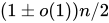
With high probability, the longest path from the root to the leaf of an -vertex random recursive tree has length .[1] The maximum number of children of any vertex, i.e., degree, in the tree is, with high probability, .[2] The expected distance of the th vertex from the root is the th harmonic number, from which it follows by linearity of expectation that the sum of all root-to-vertex path lengths is, with high probability, .[3] The expected number of leaves of the tree is with variance , so with high probability the number of leaves is .[4]






Applications
Zhang (2015) lists several applications of random recursive trees in modeling phenomena including disease spreading, pyramid schemes, the evolution of languages, and the growth of computer networks.[4]
References
- ^ Pittel, Boris (1994), "Note on the heights of random recursive trees and random m-ary search trees", Random Structures & Algorithms, 5 (2): 337–347, doi:10.1002/rsa.3240050207, MR 1262983
- ^ Goh, William; Schmutz, Eric (2002), "Limit distribution for the maximum degree of a random recursive tree", Journal of Computational and Applied Mathematics, 142 (1): 61–82, Bibcode:2002JCoAM.142...61G, doi:10.1016/S0377-0427(01)00460-5, MR 1910519
- ^ Dobrow, Robert P.; Fill, James Allen (1999), "Total path length for random recursive trees", Combinatorics, Probability and Computing, 8 (4): 317–333, doi:10.1017/S0963548399003855, MR 1723646, S2CID 40574756
- ^ a b Zhang, Yazhe (2015), "On the number of leaves in a random recursive tree" (PDF), Brazilian Journal of Probability and Statistics, 29 (4): 897–908, doi:10.1214/14-BJPS252, MR 3397399
Content Disclaimer
Informasi ini disarikan dari Wikipedia dan disajikan kembali untuk tujuan edukasi. Konten tersedia di bawah lisensi CC BY-SA 3.0. Kami tidak bertanggung jawab atas ketidakakuratan data yang bersumber dari kontribusi publik tersebut.
- The information displayed on this website is sourced in part or in whole from Wikipedia and has been adapted for the purpose of restating it. We strive to provide accurate and relevant information, however:
- There is no guarantee of absolute accuracy. Wikipedia is an open, collaborative project that can be edited by anyone, so information is subject to change.
- It is not intended to constitute professional advice. The content displayed is for informational and educational purposes only. For important decisions (e.g., medical, legal, or financial), please consult a professional.
- Content copyright. Wikipedia is licensed under the Creative Commons Attribution-ShareAlike License (CC BY-SA). This means that content may be reused with appropriate attribution and shared under a similar license.
- Responsible use. Any risk arising from the use of information from this website is entirely the responsibility of the user.