Rheonomous
A mechanical system is rheonomous if its equations of constraints contain the time as an explicit variable.[1][2] Such constraints are called rheonomic constraints. The opposite of rheonomous scleronomous.[1][2]
Example: simple 2D pendulum

As shown at right, a simple pendulum is a system composed of a weight and a string. The string is attached at the top end to a pivot and at the bottom end to a weight. Being inextensible, the string has a constant length. Therefore, this system is scleronomous; it obeys the scleronomic constraint
- ,
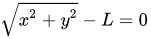
where is the position of the weight and the length of the string.


The situation changes if the pivot point is moving, e.g. undergoing a simple harmonic motion
- ,

where is the amplitude, the angular frequency, and time.


Although the top end of the string is not fixed, the length of this inextensible string is still a constant. The distance between the top end and the weight must stay the same. Therefore, this system is rheonomous; it obeys the rheonomic constraint
- .

See also
References
- ^ a b Goldstein, Herbert (1980). Classical Mechanics (2nd ed.). United States of America: Addison Wesley. p. 12. ISBN 0-201-02918-9.
Constraints are further classified according as the equations of constraint contain the time as an explicit variable (rheonomous) or are not explicitly dependent on time (scleronomous).
- ^ a b Spiegel, Murray R. (1994). Theory and Problems of THEORETICAL MECHANICS with an Introduction to Lagrange's Equations and Hamiltonian Theory. Schaum's Outline Series. McGraw Hill. p. 283. ISBN 0-07-060232-8.
In many mechanical systems of importance the time t does not enter explicitly in the equations (2) or (3). Such systems are sometimes called scleronomic. In others, as for example those involving moving constraints, the time t does enter explicitly. Such systems are called rheonomic.
Content Disclaimer
Informasi ini disarikan dari Wikipedia dan disajikan kembali untuk tujuan edukasi. Konten tersedia di bawah lisensi CC BY-SA 3.0. Kami tidak bertanggung jawab atas ketidakakuratan data yang bersumber dari kontribusi publik tersebut.
- The information displayed on this website is sourced in part or in whole from Wikipedia and has been adapted for the purpose of restating it. We strive to provide accurate and relevant information, however:
- There is no guarantee of absolute accuracy. Wikipedia is an open, collaborative project that can be edited by anyone, so information is subject to change.
- It is not intended to constitute professional advice. The content displayed is for informational and educational purposes only. For important decisions (e.g., medical, legal, or financial), please consult a professional.
- Content copyright. Wikipedia is licensed under the Creative Commons Attribution-ShareAlike License (CC BY-SA). This means that content may be reused with appropriate attribution and shared under a similar license.
- Responsible use. Any risk arising from the use of information from this website is entirely the responsibility of the user.