Run of a sequence
 | This article includes a list of general references but lacks sufficient corresponding inline citations. (June 2021) |
 | This article needs more citations. (April 2021) |
In computer science, a run of a sequence is a non-decreasing range of the sequence that cannot be extended. The number of runs of a sequence is the number of increasing subsequences of the sequence. This is a measure of presortedness, and in particular measures how many subsequences must be merged to sort a sequence.
Definition
Let be a sequence of elements from a totally ordered set. A run of is a maximal increasing sequence . That is, and [clarification needed] assuming that and exists. For example, if is a natural number, the sequence has the two runs and .








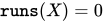
Let be defined as the number of positions such that and . It is equivalently defined as the number of runs of minus one. This definition ensure that , that is, the if, and only if, the sequence is sorted. As another example, and .





Sorting sequences with a low number of runs
The function is a measure of presortedness. The natural merge sort is -optimal. That is, if it is known that a sequence has a low number of runs, it can be efficiently sorted using the natural merge sort.

Long runs
A long run is defined similarly to a run, except that the sequence can be either non-decreasing or non-increasing. The number of long runs is not a measure of presortedness. A sequence with a small number of long runs can be sorted efficiently by first reversing the decreasing runs and then using a natural merge sort.
References
- Powers, David M. W.; McMahon, Graham B. (1983). "A compendium of interesting prolog programs". DCS Technical Report 8313 (Report). Department of Computer Science, University of New South Wales.
- Mannila, H (1985). "Measures of Presortedness and Optimal Sorting Algorithms". IEEE Trans. Comput. (C-34): 318–325. doi:10.1109/TC.1985.5009382.
Content Disclaimer
Informasi ini disarikan dari Wikipedia dan disajikan kembali untuk tujuan edukasi. Konten tersedia di bawah lisensi CC BY-SA 3.0. Kami tidak bertanggung jawab atas ketidakakuratan data yang bersumber dari kontribusi publik tersebut.
- The information displayed on this website is sourced in part or in whole from Wikipedia and has been adapted for the purpose of restating it. We strive to provide accurate and relevant information, however:
- There is no guarantee of absolute accuracy. Wikipedia is an open, collaborative project that can be edited by anyone, so information is subject to change.
- It is not intended to constitute professional advice. The content displayed is for informational and educational purposes only. For important decisions (e.g., medical, legal, or financial), please consult a professional.
- Content copyright. Wikipedia is licensed under the Creative Commons Attribution-ShareAlike License (CC BY-SA). This means that content may be reused with appropriate attribution and shared under a similar license.
- Responsible use. Any risk arising from the use of information from this website is entirely the responsibility of the user.