Scott information system
In domain theory, a branch of mathematics and computer science, a Scott information system is a primitive kind of logical deductive system often used as an alternative way of presenting Scott domains.
Definition
A Scott information system, A, is an ordered triple




satisfying





Here means


Examples
Natural numbers
The return value of a partial recursive function, which either returns a natural number or goes into an infinite recursion, can be expressed as a simple Scott information system as follows:



That is, the result can either be a natural number, represented by the singleton set , or "infinite recursion," represented by .


Of course, the same construction can be carried out with any other set instead of .

Propositional calculus
The propositional calculus gives us a very simple Scott information system as follows:



Scott domains
Let D be a Scott domain. Then we may define an information system as follows
- the set of compact elements of




Let be the mapping that takes us from a Scott domain, D, to the information system defined above.

Information systems and Scott domains
Given an information system, , we can build a Scott domain as follows.

- Definition: is a point if and only if



Let denote the set of points of A with the subset ordering. will be a countably based Scott domain when T is countable. In general, for any Scott domain D and information system A

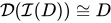
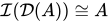
where the second congruence is given by approximable mappings.
See also
References
- Glynn Winskel: "The Formal Semantics of Programming Languages: An Introduction", MIT Press, 1993 (chapter 12)
Content Disclaimer
Informasi ini disarikan dari Wikipedia dan disajikan kembali untuk tujuan edukasi. Konten tersedia di bawah lisensi CC BY-SA 3.0. Kami tidak bertanggung jawab atas ketidakakuratan data yang bersumber dari kontribusi publik tersebut.
- The information displayed on this website is sourced in part or in whole from Wikipedia and has been adapted for the purpose of restating it. We strive to provide accurate and relevant information, however:
- There is no guarantee of absolute accuracy. Wikipedia is an open, collaborative project that can be edited by anyone, so information is subject to change.
- It is not intended to constitute professional advice. The content displayed is for informational and educational purposes only. For important decisions (e.g., medical, legal, or financial), please consult a professional.
- Content copyright. Wikipedia is licensed under the Creative Commons Attribution-ShareAlike License (CC BY-SA). This means that content may be reused with appropriate attribution and shared under a similar license.
- Responsible use. Any risk arising from the use of information from this website is entirely the responsibility of the user.