Shooting and bouncing rays
The shooting and bouncing rays (SBR) method in computational electromagnetics was first developed for computation of radar cross section (RCS).[1] Since then, the method has been generalized to be used also for installed antenna performance. The SBR method is an approximate method applied to high frequencies. The method can be implemented for GPU computing, which makes the computation very efficient.
Theory
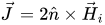
The first step in the SBR method is to use geometrical optics (GO, ray-tracing) for computing equivalent currents, either on metallic structures or on an exit aperture. The scattered field is thereafter computed by integrating these currents using physical optics (PO), by the Kirchhoff's diffraction formula. The current on a perfect electrical conductor (PEC) is related to the incident magnetic field by . This approximation holds best for short wavelengths, and it assumes that the radius of curvature of the scatterer is large compared to the wavelength.[2]


Extending SBR for edge diffraction
Since the approximation described above assumes that the radius of curvature is large compared to the wavelength, the diffraction from edges needs to be handled separately. The SBR method can be extended with physical theory of diffraction (PTD) in order to include edge diffraction in the model.
Implementation in commercial software
The SBR method is implemented in the following commercial codes:
- Altair Feko (method there known as RL-GO - Ray Launching Geometrical Optics)
- CST Microwave Studio, Asymptotic Solver
- Ansys HFSS SBR+, previously Delcross Savant
- XGTD
See also
References
- ^ Ling, Hao; et al. (1989). "Shooting and bouncing rays: calculating the RCS of an arbitrarily shaped cavity". IEEE Transactions on Antennas and Propagation. 37 (2): 194. Bibcode:1989ITAP...37..194L. doi:10.1109/8.18706.
- ^ Kristensson, Gerhard (2016). Scattering of electromagnetic waves by obstacles. Scitech. p. 295. ISBN 978-1-61353-222-5.
Content Disclaimer
Informasi ini disarikan dari Wikipedia dan disajikan kembali untuk tujuan edukasi. Konten tersedia di bawah lisensi CC BY-SA 3.0. Kami tidak bertanggung jawab atas ketidakakuratan data yang bersumber dari kontribusi publik tersebut.
- The information displayed on this website is sourced in part or in whole from Wikipedia and has been adapted for the purpose of restating it. We strive to provide accurate and relevant information, however:
- There is no guarantee of absolute accuracy. Wikipedia is an open, collaborative project that can be edited by anyone, so information is subject to change.
- It is not intended to constitute professional advice. The content displayed is for informational and educational purposes only. For important decisions (e.g., medical, legal, or financial), please consult a professional.
- Content copyright. Wikipedia is licensed under the Creative Commons Attribution-ShareAlike License (CC BY-SA). This means that content may be reused with appropriate attribution and shared under a similar license.
- Responsible use. Any risk arising from the use of information from this website is entirely the responsibility of the user.