Signomial
A signomial is an algebraic function of one or more independent variables. It is perhaps most easily thought of as an algebraic extension of multivariable polynomials—an extension that permits exponents to be arbitrary real numbers (rather than just non-negative integers) while requiring the independent variables to be strictly positive (so that division by zero and other inappropriate algebraic operations are not encountered).
Formally, a signomial is a function with domain which takes values

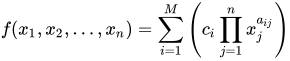
where the coefficients and the exponents are real numbers. Signomials are closed under addition, subtraction, multiplication, and scaling.


If we restrict all to be positive, then the function f is a posynomial. Consequently, each signomial is either a posynomial, the negative of a posynomial, or the difference of two posynomials. If, in addition, all exponents are non-negative integers, then the signomial becomes a polynomial whose domain is the positive orthant.
For example,

is a signomial.
The term "signomial" was introduced by Richard J. Duffin and Elmor L. Peterson in their seminal joint work on general algebraic optimization—published in the late 1960s and early 1970s. A recent introductory exposition involves optimization problems.[1] Nonlinear optimization problems with constraints and/or objectives defined by signomials are harder to solve than those defined by only posynomials, because (unlike posynomials) signomials cannot necessarily be made convex by applying a logarithmic change of variables. Nevertheless, signomial optimization problems often provide a much more accurate mathematical representation of real-world nonlinear optimization problems.
See also
References
- ^ C. Maranas and C. Floudas, Global optimization in generalized geometric programming, pp. 351–370, 1997.
External links
- S. Boyd, S. J. Kim, L. Vandenberghe, and A. Hassibi, A Tutorial on Geometric Programming
Content Disclaimer
Informasi ini disarikan dari Wikipedia dan disajikan kembali untuk tujuan edukasi. Konten tersedia di bawah lisensi CC BY-SA 3.0. Kami tidak bertanggung jawab atas ketidakakuratan data yang bersumber dari kontribusi publik tersebut.
- The information displayed on this website is sourced in part or in whole from Wikipedia and has been adapted for the purpose of restating it. We strive to provide accurate and relevant information, however:
- There is no guarantee of absolute accuracy. Wikipedia is an open, collaborative project that can be edited by anyone, so information is subject to change.
- It is not intended to constitute professional advice. The content displayed is for informational and educational purposes only. For important decisions (e.g., medical, legal, or financial), please consult a professional.
- Content copyright. Wikipedia is licensed under the Creative Commons Attribution-ShareAlike License (CC BY-SA). This means that content may be reused with appropriate attribution and shared under a similar license.
- Responsible use. Any risk arising from the use of information from this website is entirely the responsibility of the user.