Singularity function
Singularity functions are a class of discontinuous functions that contain singularities, i.e., they are discontinuous at their singular points. Singularity functions have been heavily studied in the field of mathematics under the alternative names of generalized functions and distribution theory.[1][2][3] The functions are notated with brackets, as where n is an integer. The "" are often referred to as singularity brackets. The functions are defined as:


n -2 -1 0 1 2

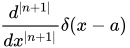






where: δ(x) is the Dirac delta function, also called the unit impulse. The first derivative of δ(x) is also called the unit doublet. The function is the Heaviside step function: H(x) = 0 for x < 0 and H(x) = 1 for x > 0. The value of H(0) will depend upon the particular convention chosen for the Heaviside step function. Note that this will only be an issue for n = 0 since the functions contain a multiplicative factor of x − a for n > 0. is also called the ramp function.


Integration
Integrating can be done in a convenient way in which the constant of integration is automatically included so the result will be 0 at x = a.

Example beam calculation
The deflection of a simply supported beam, as shown in the diagram, with constant cross-section and elastic modulus, can be found using Euler–Bernoulli beam theory. Here, we are using the sign convention of downward forces and sagging bending moments being positive.

Load distribution:

Shear force:


Bending moment:
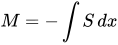

Slope:
- Because the slope is not zero at x = 0, a constant of integration, c, is added
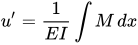

Deflection:


The boundary condition u = 0 at x = 4 m allows us to solve for c = −7 Nm2
See also
References
External links
Content Disclaimer
Informasi ini disarikan dari Wikipedia dan disajikan kembali untuk tujuan edukasi. Konten tersedia di bawah lisensi CC BY-SA 3.0. Kami tidak bertanggung jawab atas ketidakakuratan data yang bersumber dari kontribusi publik tersebut.
- The information displayed on this website is sourced in part or in whole from Wikipedia and has been adapted for the purpose of restating it. We strive to provide accurate and relevant information, however:
- There is no guarantee of absolute accuracy. Wikipedia is an open, collaborative project that can be edited by anyone, so information is subject to change.
- It is not intended to constitute professional advice. The content displayed is for informational and educational purposes only. For important decisions (e.g., medical, legal, or financial), please consult a professional.
- Content copyright. Wikipedia is licensed under the Creative Commons Attribution-ShareAlike License (CC BY-SA). This means that content may be reused with appropriate attribution and shared under a similar license.
- Responsible use. Any risk arising from the use of information from this website is entirely the responsibility of the user.